Anti-Money Laundering Monitoring, Digital and Financial Crime Surveillance, Global Sanction and PEP Screening And Reporting Software
AML / CFT Risk Based Supervision Repository Listing (CBN AML/CFT RBS) In Compliance Planet Anti Money Laundering/Core Banking Finance Software
The Compliance planet software keeps a record list of all AML RBS reports that have been manually scheduled. Here is how to find your scheduled AML RBS reports and make use of other features on the page.
NOTE: Only person(s) assigned right to ‘view RBS Report’ can carry out these operation(s)
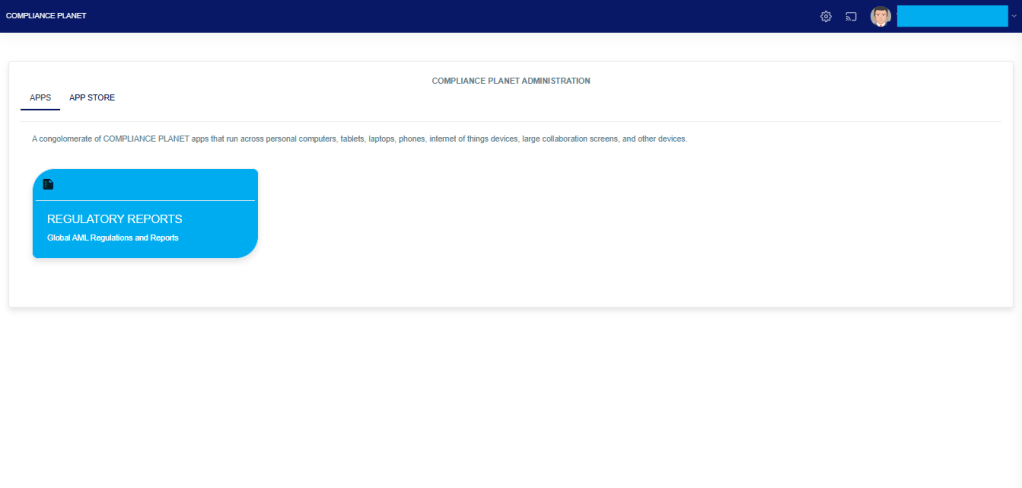
From the app dashboard, click on “REGULATORY REPORTS” as displayed in the image below.
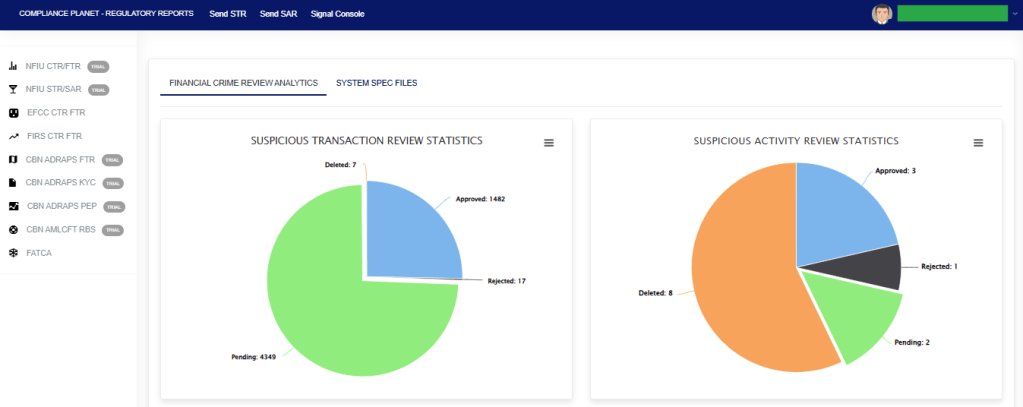
This will display a drop-down, as shown in image below. The drop-down menu lists the report types available on the Compliance Planet software.
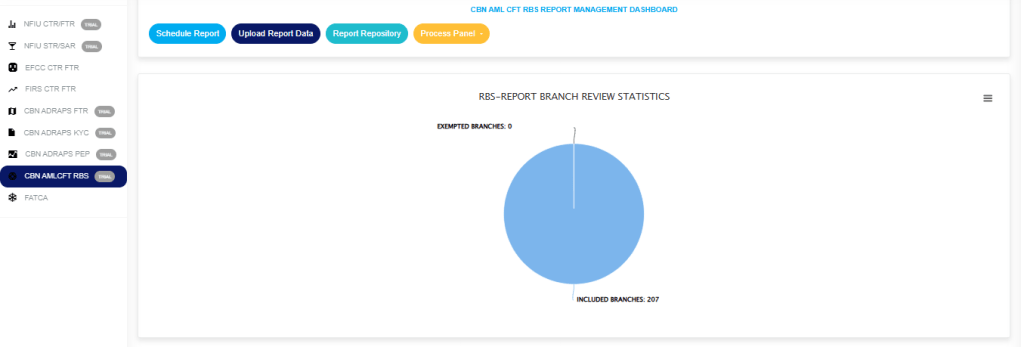
Click “CBN AML/CFT RBS” on the drop-down list and display the RBS REPORT BRANCH REVIEW STATISTICS Page as displayed in the image below.
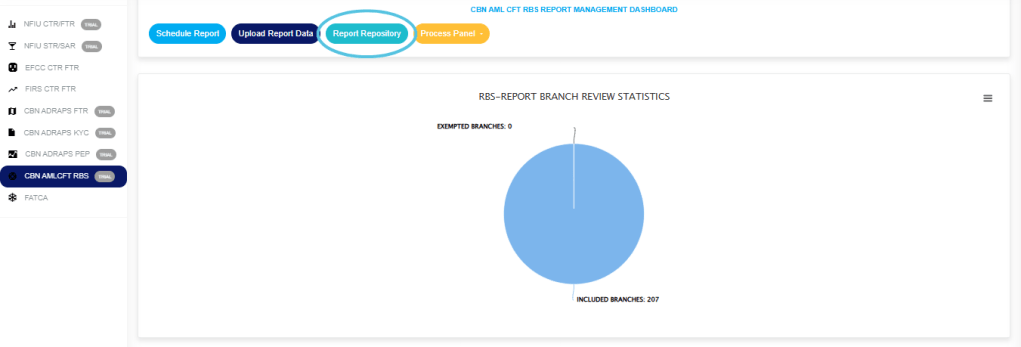
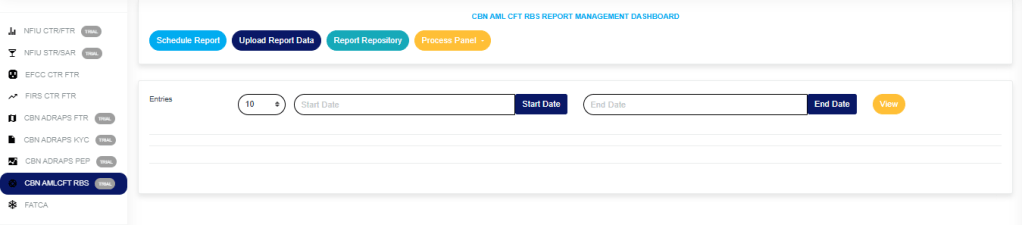
STEP 1: From the top menu click on ‘Report Repository’ as in fig.7.4a below.
(fig. 7.4a)
This displays a page as in fig. 7.4b. On this page you can view list of Risk Based Supervision Reports that have been previously scheduled when you specify a start date and end date for a period.
(fig. 7.4b)
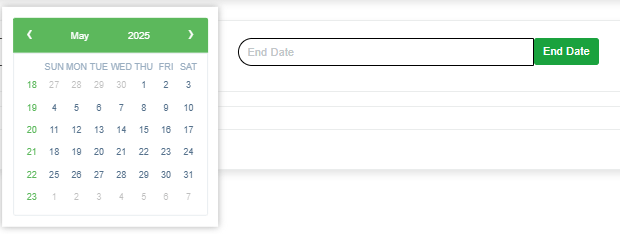
STEP 2: Click on the “START DATE“button/box and the “END DATE“button/box to specify the beginning and the end of the period for which the reports you want to see have been scheduled for. Fig. 7.4c and fig. 7.4d are examples on setting a Start Date and an End Date.
(fig. 7.4c)
(fig. 7.4d)
Take a look at the arrows labelled a – d in fig. 7.4e to study learn of how to use the calendar.
Click on the given year to change it to your year of choice.
Click on the given month to change it to your month of choice.
Then, click on the date of the month.
You can also click on the angle brackets on the calendar [ ‘<’ or ‘>’ ] to go backward or forward.
(fig.7.4e)
For instance, to see AML RBS reports scheduled for dates between JANUARY 2025 and APRIL 2025, the start date and end date would be 2025/01/01 and 2025/01/01 respectively. See an example in fig. 7.4f below.
(fig. 7.4f)
STEP 3: Click on ‘VIEW’ as in fig. 7.4g to see the reports. This is an orange button at the top-right area of the page.
(fig. 7.4g)
The software will make a search and the reports that were scheduled for that period you have entered in the date boxes will be displayed. See the results of the example in fig. 7.4h.
(fig. 7.4h)
You can make changes to the date you specified earlier. When you change the date entries, click on view to see the reports for the new date range you have just set.
At the Top end and Bottom end of the page, the software gives information about the number of pages of your result, with the page numbers written out. Click on any page number to go to that particular page. Click on “NEXT” to go to the next page or click on “PREVIOUS” to go to the page before the current page.
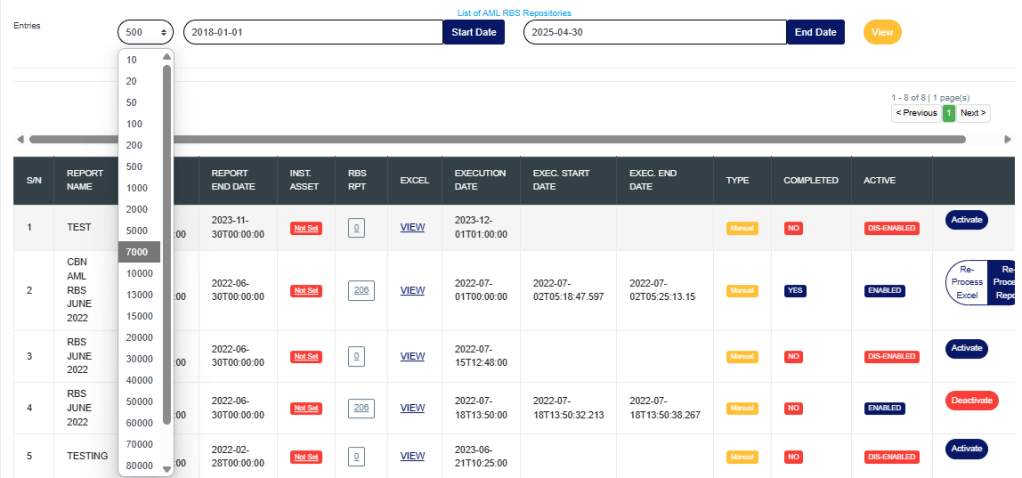
For each report on the AML RBS list, the software will provide information on the report name, report start date and end date, institution asset data has been set or not, the number of the institution’s branches involved, the report execution date and time, the report execution start date and end date, the type of report, a comment on whether the processing of the report has been completed or not and the processing status (for reports that have not been processed). Each report has a button to view the download history of Excel files the software has exported report information into.
Adjust the number of reports you want to see per page by clicking on the “ENTRIES” box as in fig. 7.4i.
(fig.7.4i)
Click on a report’s ‘Inst. Asset’ comment as in fig. 7.4j to view and/or edit the institution asset data. The institution asset data refers to the name, code, address and number of assets of an institution.
(fig. 7.4j)
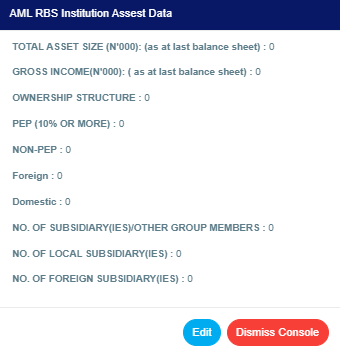
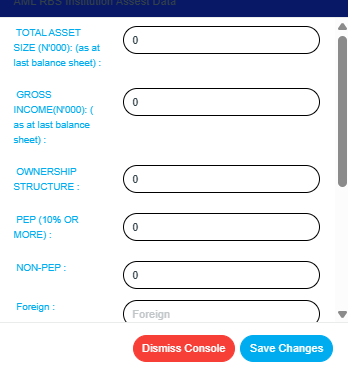
This displays the ‘AML RBS Institution Asset Data’ console as in fig. 7.4k below. This console provides information on the institution’s asset size, gross income, ownership structure, number of subsidiaries or other group members, local subsidiaries, foreign subsidiaries and other information.
(fig. 7.4k)
Click on ‘EDIT’ to modify any of the information displayed. See fig. 7.4l.
Fill the details and click on ‘Save changes’ to update the information.
NOTE: Only Persons assigned right(s) to ‘Edit RBS reports’ can EDIT Institution asset data
(fig. 7.4l)
A confirmation console as in fig. 7.4n will be displayed. Click on ‘CONFIRM’ to proceed or ‘CANCEL’ to discontinue.
(fig. 7.4n)
Click on a report’s ‘RBS Rpt’ number to see the details of the branches included in the report.
(fig. 7.4o)
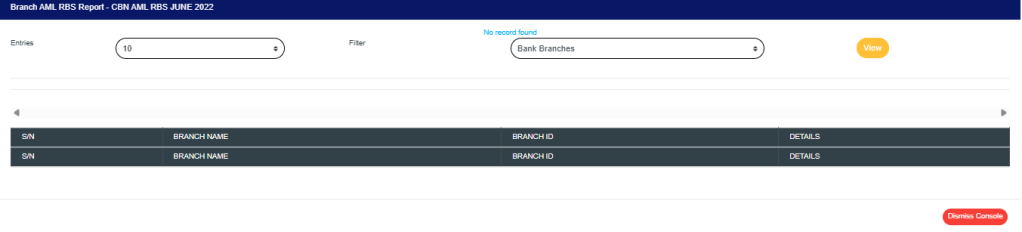
This displays a console will be displayed as in fig. 7.4p below.
(fig. 7.4p)
See the following steps (a – c) on how to make use of the features on this page.
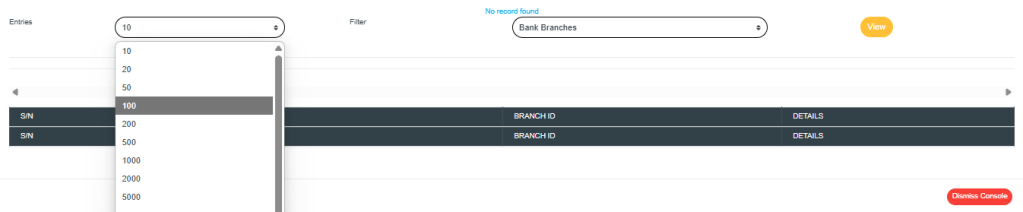
Click on the ‘ENTRIES’ box as in fig. 7.4q below to adjust the number of branches you want to see per page.
(fig. 7.4q)
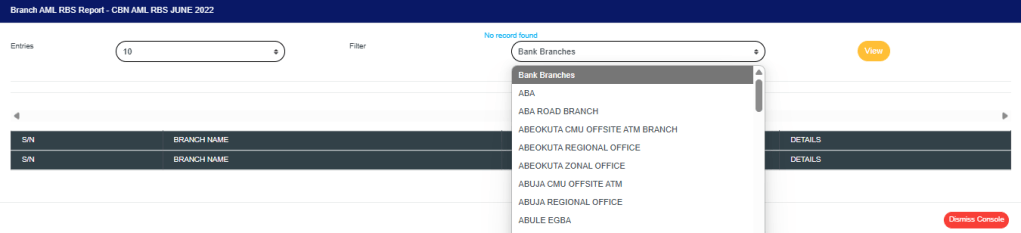
Click on the ‘FILTER’ box to select a bank branch as in fig. 7.4r below.
(fig. 7.4r)
After selecting the bank branch of your choice, click on VIEW as in fig. 7.4s.
(fig. 7.4s)
Click on ‘VIEW’ under the ‘Excel’ column of a report as shown in fig. 7.4t to see its excel file download history.
(fig. 7.4t)
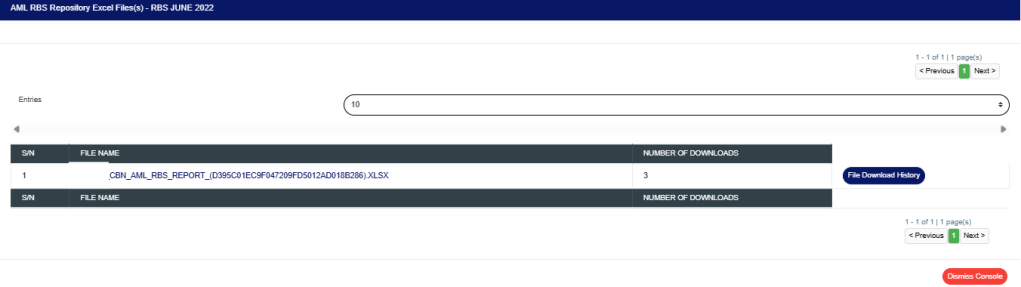
This display an AML RBS excel file repository’ console as in fig. 7.4u. This page gives information about the users that have downloaded the excel file
(fig. 7.4u)
Click on the file name to download the file.
NOTE: Only person(s) assigned right to ‘view RBS Report’ and ‘download RBS Report’ can carry out these operation(s)
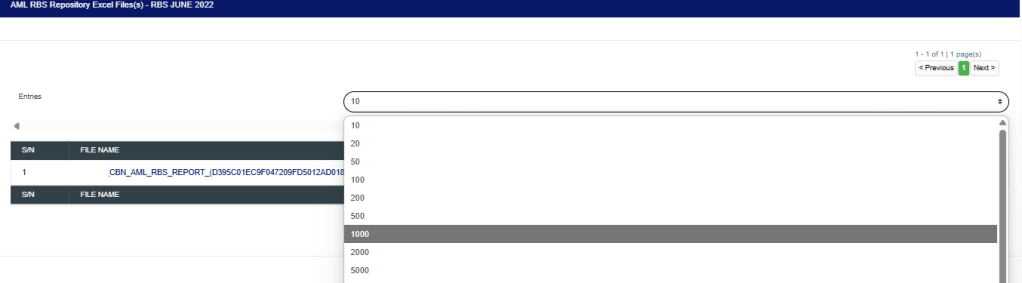
Click on the ‘ENTRIES’ box as in fig. 7.4v to adjust the number of Excel files you want to see per page.
(fig. 7.4v)
Click on ‘file download history’ as shown in fig 7.5u above to see the record of those that downloaded the file. See an example of the download history console below
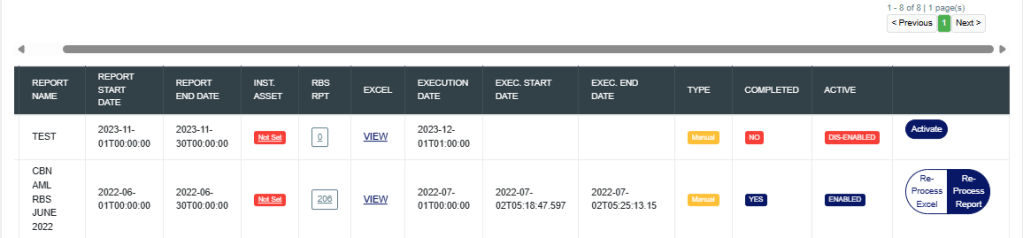
Also on the AML RBS Repository list page, at the end of each report row, the software shows if the processing of the report is enabled or dis-enabled under the ‘ACTIVE’ column.
For reports that have been completed, their status will read, ENABLED. See fig. 7.4x for an instance.
(fig. 7.4x)
For reports that have not been completed, there will be an extra button next to their ACTIVE status. This button is used to ACTIVATE or DEACTIVATE the processing of the report. Also see fig. 7.4w above.
Click on Activate to enable the processing of report. This turns the status bar of the report to green with an ‘ENABLED’ inscription. See fig. 7.4y and fig. 7.4z for an example.
(fig. 7.4y)
(fig. 7.4z)
A notification will be displayed at the top of the page when activation is successful. See fig. 7.4aa for an example.
Click on Deactivate to disable the processing of the report. This turns the status bar to red with a ‘DIS-ENABLED’ inscription. See fig.7.4ab and fig. 7.4ac to see the result of deactivating a report also.
(fig. 7.4ab)
(fig. 7.4ac)
A notification will be displayed at the top of the page when deactivation is successful. See fig. 7.4ad for an example.
(fig. 7.4ad
NOTE: Only person(s) profiled and assigned right(s) to ‘Edit RBS Report’ will be able to activate or de-activate a report