Overview Of Branch Codes In Compliance Planet Anti Money Laundering/Core Banking Finance Software

This section provides a guide on how to perform operations pertaining to Branch codes on the Compliance Planet, with step-by-step instructions and pictures.

A branch refers to a retail location where a financial institution offers a wide array of face-to-face and automated services to its customers. It is also referred to as ‘KIOSK’ on the compliance planet. Every branch of a bank has a unique code referred to as ‘Branch code’. This code distinguishes a branch from another. Every branch code has a description (Branch Description) which basically tells the area where that branch is located. A branch code is also referred to as ‘Sort Code’.

BRANCH CODE OPERATIONS

Under this feature, the compliance planet provides a list of the branch codes of the financial institution and their descriptions. The operations pertaining to branch codes on the planet include creating a new branch, activating or deactivating a branch and deleting a branch, with options to carry out bulk operations also.

NOTE: Only person(s) profiled as deputy supreme admin can carry out these operations 

To perform any of the operations on branch codes;

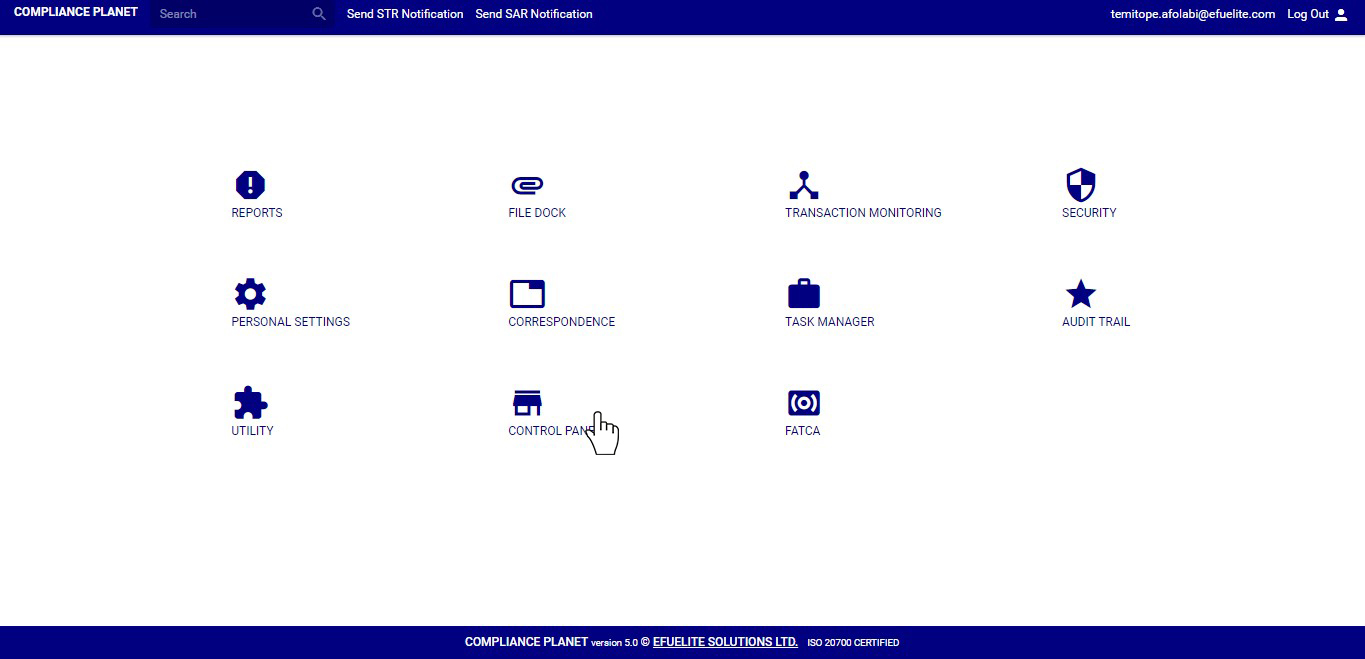
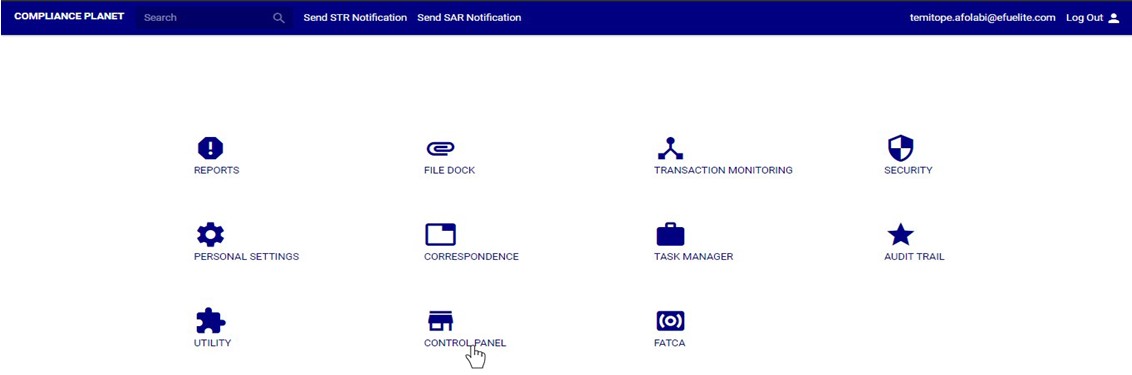
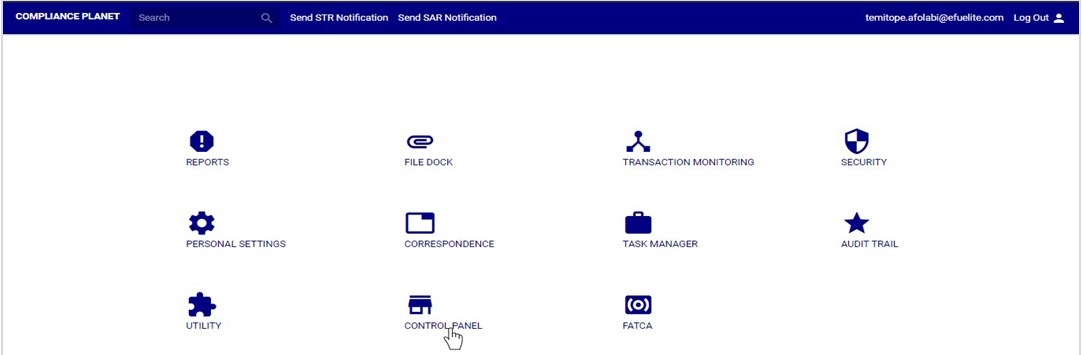
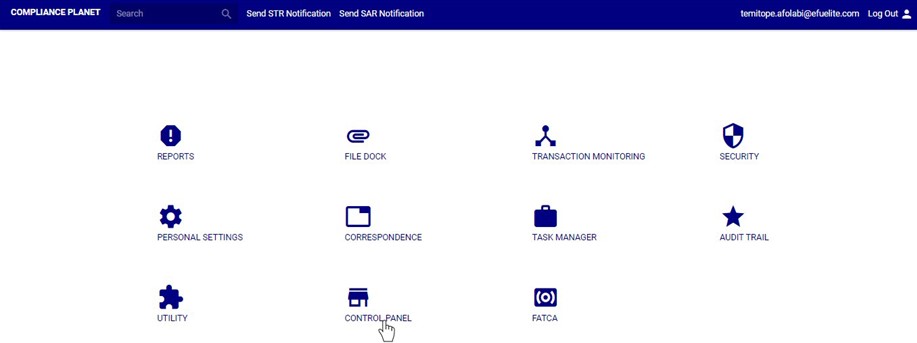
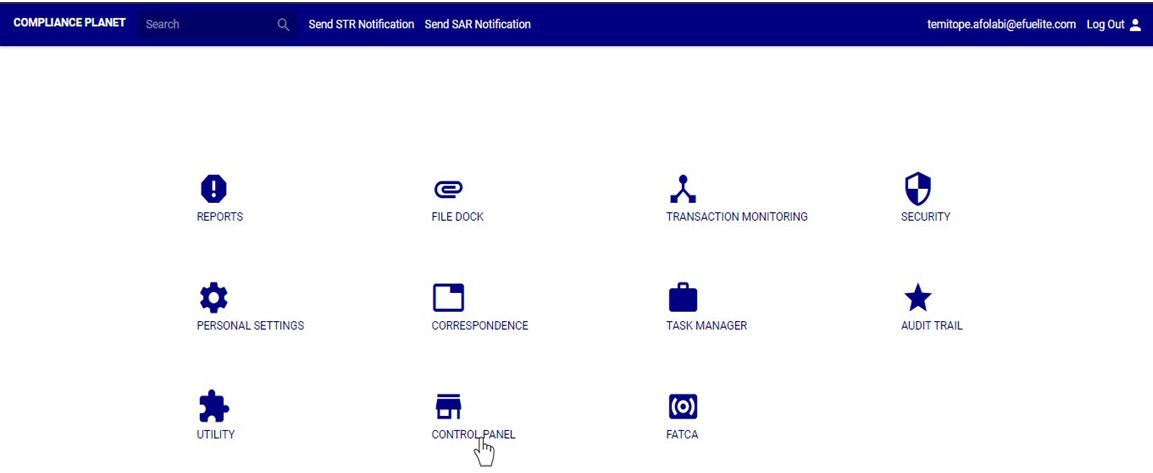
STEP 1: From the main dashboard, click ‘CONTROL PANEL’ as in fig 19.2a below.

(fig. 19.2a)

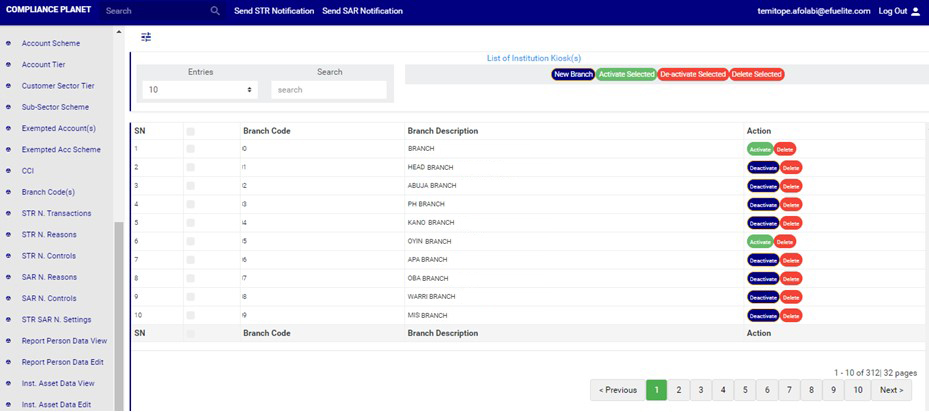
➔ STEP 2: Click on ‘BRANCH CODE(S)’ from the left hand side menu as in fig. 19.2b below.

(fig. 19.2b)

➔ This displays a page showing a list of all the financial institution’s branch codes and their descriptions as in fig. 19.2c.

(fig. 19.2c)

For further enquiries :
Tel +234(0) 816 555 9818
Email solutions@efuelite.com

Web http://solutions.efuelite.com

How To Carry Out Sub Sector Scheme Operations In Compliance Planet Anti Money Laundering/Core Banking Finance Software

The operations pertaining to SUB-SECTOR SCHEME on the Compliance Planet are:

1. Editing a sub-sector scheme

2. Deleting a sub-sector scheme

3. Creating a new sub-sector scheme

4. Downloading all sub-sector schemes

5. Bulk delete of sub-sector schemes

6. Bulk upload of new sub-sector schemes

The last three (3) operations are for bulk operations.

NOTE: Only person(s) profiled as deputy supreme admin can carry out these operations.

To perform any of the sub-sector scheme operations;

STEP 1: From the main dashboard, click on ‘CONTROL PANEL’ in fig 15.2a below

(fig. 15.2a)

STEP 2: Click on ‘SUB-SECTOR SCHEME’ on the left hand side menu. See this in fig. 15.2b below.

(fig. 15.2b)

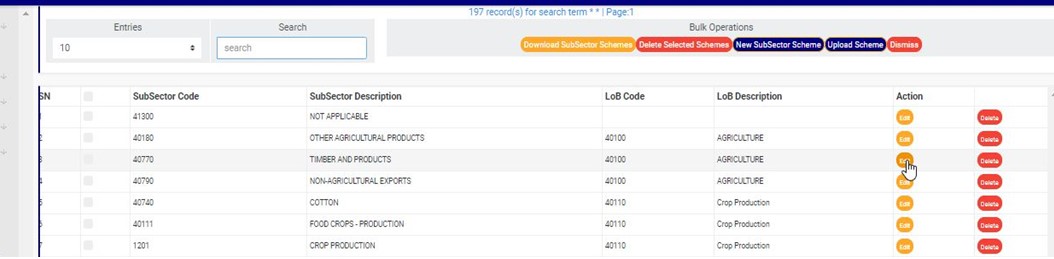
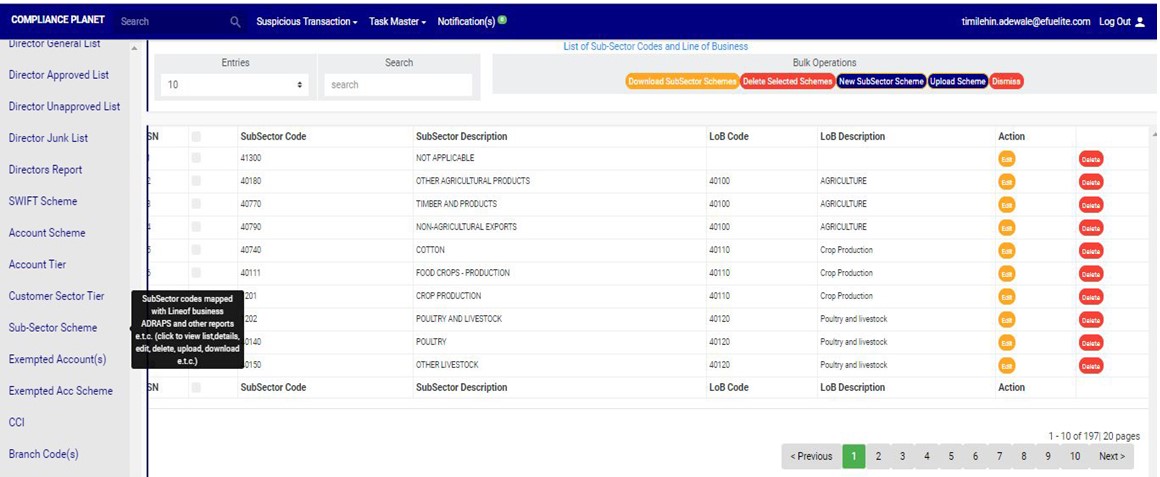
➔ This displays a page showing a list of all sub-sectors and their respective lines of business. See fig. 15.2c below for an example.

(fig. 15.2c)

➔ Click on the ‘ENTRIES’ box to adjust the number of sub-sector schemes you see per page. See fig. 15.2d.

(fig. 15.2d)

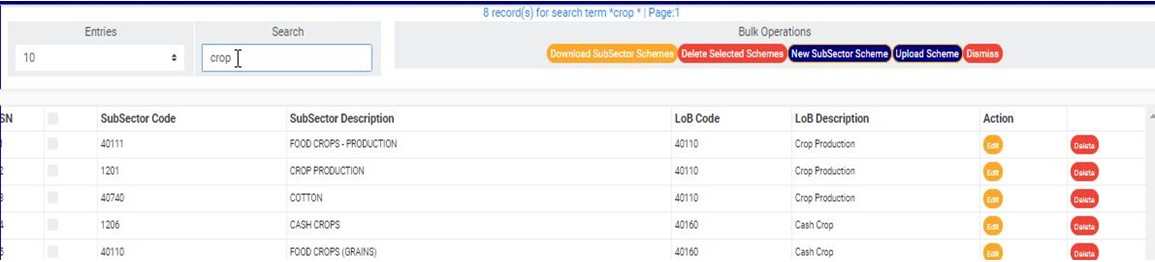
➔ Search for Sub-sector Schemes by inputting the sub-sector code, sub-sector description, line of business code or line of business description in the search box. Search results will appear immediately a character is typed in the search box.. See an example of a search in fig. 15.2e.

(fig. 15.2e)

➔ At the bottom-right corner of the page, the software supplies information about the number of pages of the list, with the page numbers written out. The page numbers represent buttons to go to each page. By clicking on any page number, the planet takes you to that particular page. Click on the ‘NEXT’ button to go to the next page or the ‘PREVIOUS’ button to go to the page before the current page. See fig. 15.2f for an example.

(fig. 15.2f)

➔ Each sub-sector scheme entry has two (2) action buttons; ‘Edit’ button and ‘Delete’ button. These buttons are placed at the end of each row. Also, at the top of the page are other buttons to carry out bulk operations. These operations are explained below.

DISMISS’ BUTTON

Click on ‘DISMISS’ to close the ‘SUB-SECTOR SCHEME’ page. Clicking on this button will close the page and take you back to the Data panel home page. This button is at the top-right corner of the page. See fig.15.2g.

(fig. 15.2g)

How To Edit Sub-Sector Scheme

This refers to changing the details of a sub-sector scheme which includes; the sub-sector code, sub-sector description and the line of business. Here is how to edit a sub-sector scheme.

STEP 1: Click on its ‘Edit’ button as shown in fig. 15.3a below.

(fig. 15.3a)

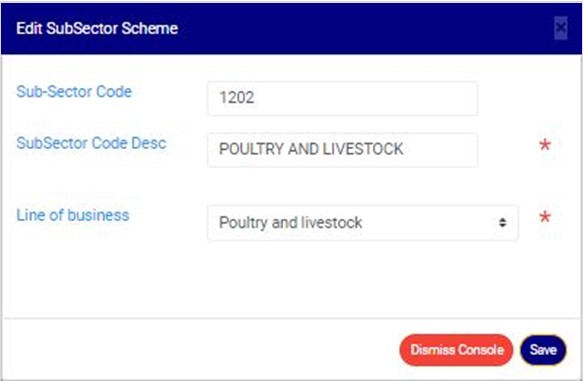
➔ This displays an ‘Edit Subsector Scheme’ console as in fig. 15.3b below.

(fig. 15.3b)

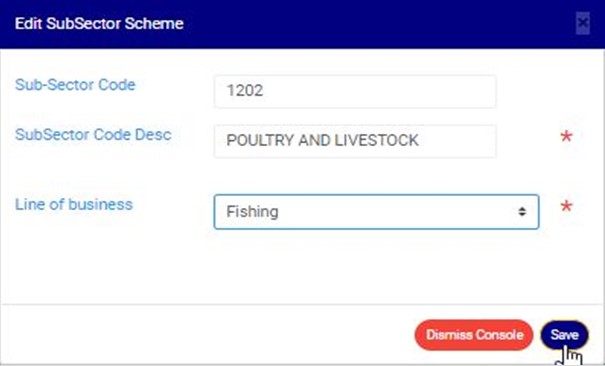
STEP 2: Fill in the new sub-sector code or new sub-sector description or select the new line of business. See fig. 15.3c for an example.

(fig. 15.3c)

STEP 3: Click on ‘SAVE’ as in fig. 15.3d to update and save the sub-sector scheme details. To close the console, click on ‘Dismiss Console’.

(fig. 15.3d)

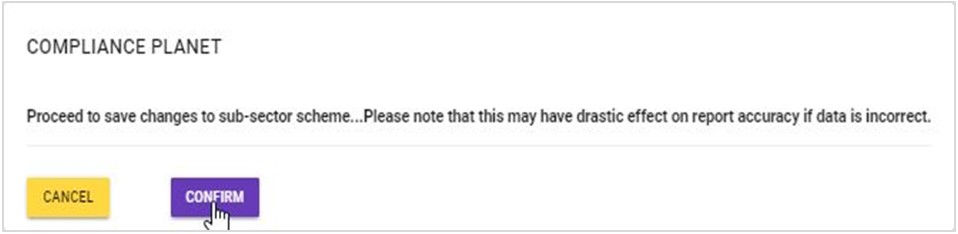
➔ This displays a confirmation console to confirm you want to save the changes.See Fig. 15.3e

STEP 4: Click on ‘CONFIRM’ to proceed or ‘CANCEL’ to discontinue.

(fig. 15.3e)

➔ By clicking on CONFIRM, a notification as in fig. 15.3f will be displayed at the top of the page when the operation is complete.

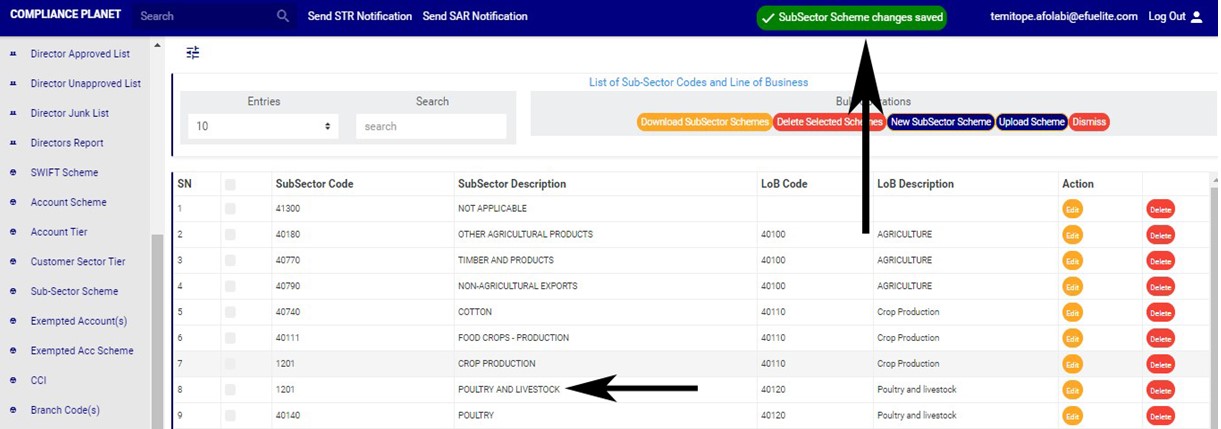
(fig. 15.3f)

15.4 How To Delete Sub-Sector Scheme

This refers to the delete of a single sub-sector scheme. Here is how to delete a sub-sector scheme.

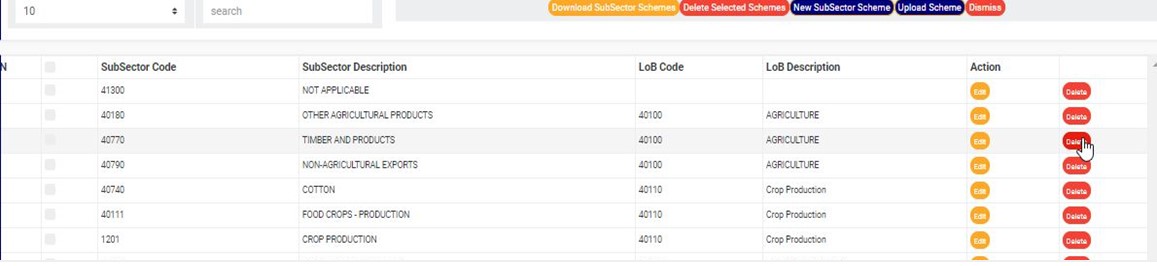
STEP 1: Click on the sub-sector’s ‘DELETE’ button as shown in fig. 15.4a below.

(fig. 15.4a)

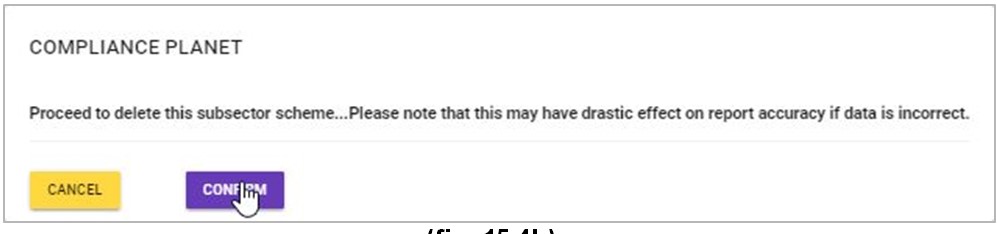
➔ A confirmation console will be displayed to confirm your request to delete the sub-sector scheme.

STEP 2: Click on ‘CONFIRM’ to proceed.as in fig. 15.4b or ‘CANCEL’ to discontinue.

(fig. 15.4b)

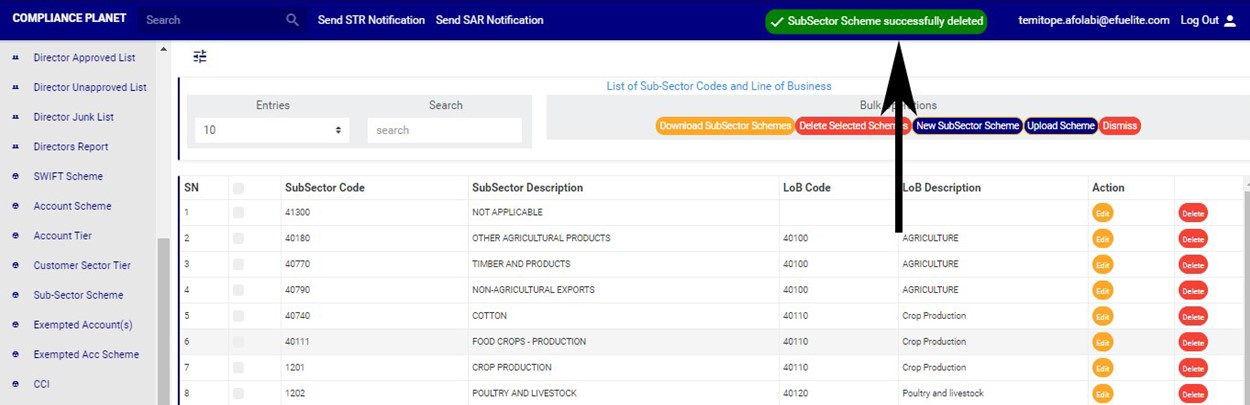
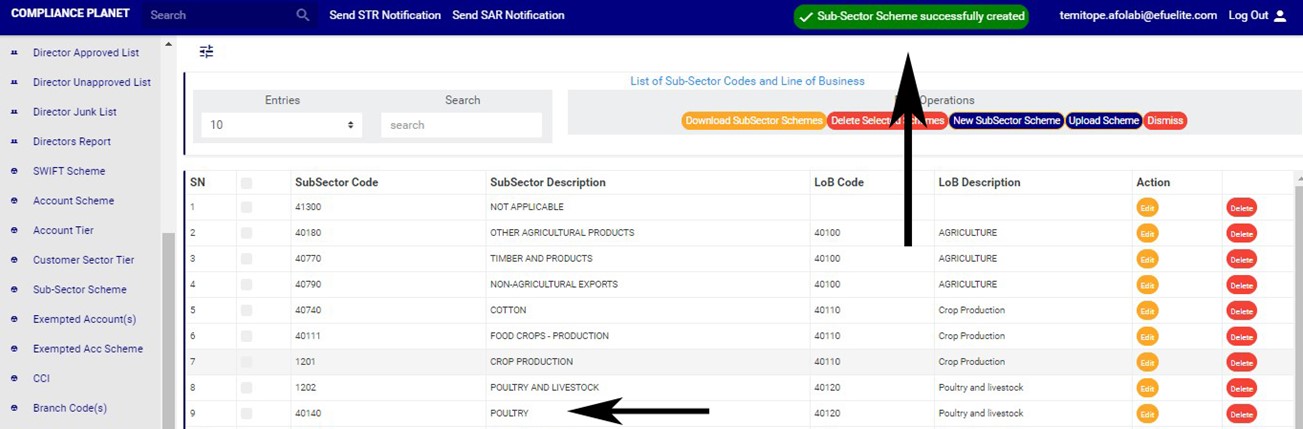
➔ If you proceed to delete the sub-sector, a notification as in fig. 15.4c will be displayed at the top of the page when the delete operation is done.

(fig. 15.4c)

How To Create New Sub-Sector Scheme

This refers to the adding of a new sub-sector scheme on the compliance planet. Here is how to create a new sub-sector scheme.

STEP 1: Click on ‘NEW SUB-SECTOR SCHEME’ as in fig. 15.5a below.

(fig. 15.5a)

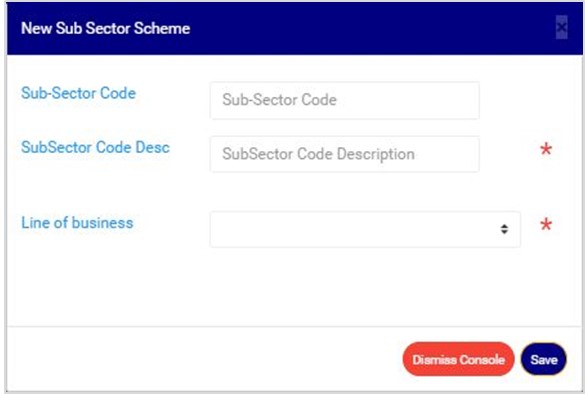
➔ This displays a ‘NEW SUB SECTOR SCHEME’ console. Here on this console, you are to input the details of the new sub-sector scheme which includes the sub-sector code and description and the line of business. See fig. 15.5b for an example.

(fig. 15.5b)

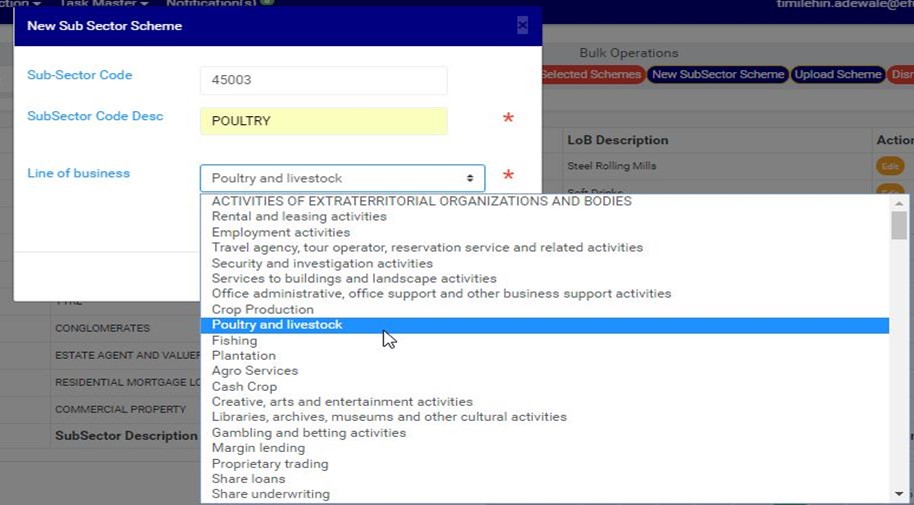
STEP 2: Fill in the details of the new sub-sector scheme. See fig. 15.5c for an example.

(fig. 15.5c)

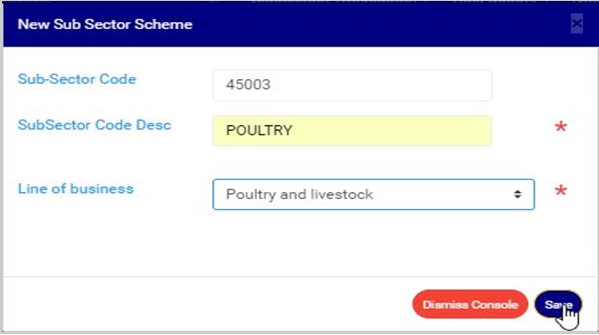
STEP 3: Click on ‘SAVE’ as shown in fig. 15.5d below.

(fig. 15.5d)

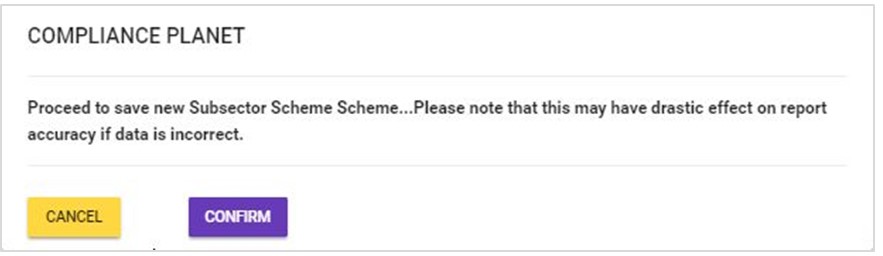
➔ This displays a confirmation console to confirm you want to add a new sub-sector scheme. See fig. 15.5e.

(fig. 15.5e)

STEP 4: Click ‘CONFIRM’ to proceed with the creation of the new sub-sector scheme or ‘CANCEL’ to discontinue. If you proceed, a notification as in fig. 15.5f will be displayed at the top of the page when the new sub-sector scheme has been successfully created.

(fig. 15.5f)

How To Download All Sub-Sector Schemes

This refers to the download of an excel file filled with all the sub-sector schemes saved on the compliance planet. Here is how to do this.

STEP 1: Click on ‘DOWNLOAD SUB-SECTOR SCHEMES’ as shown in fig. 15.6a below.

(fig. 15.6a)

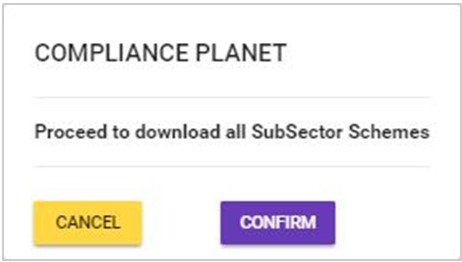
➔ This displays a confirmation console to confirm the download of all the sub-sector schemes.

(fig. 15.6b)

STEP 2: Click on ‘CONFIRM’ to proceed with the download or ‘CANCEL’ to discontinue with the operation.

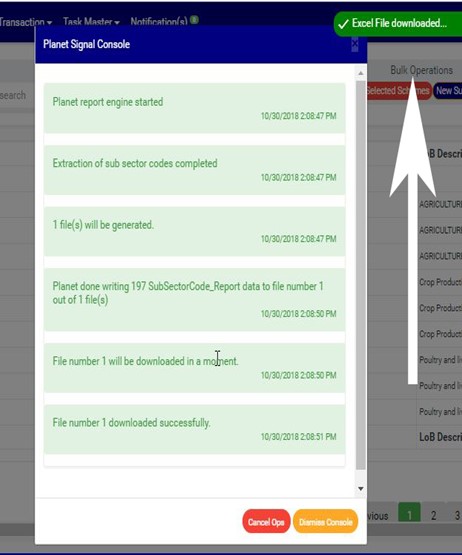
➔ The signal console shows on going processes. An example of a signal console is fig 15.6b. When download is complete, a notification will be displayed at the top of the page that an excel file has been downloaded.

(fig. 15.6c)


How To Make Bulk Delete of Sub-Sector Schemes

This refers to deleting more than one sub-sector schemes at once. Here is how to carry out a bulk delete of sub-sector schemes.

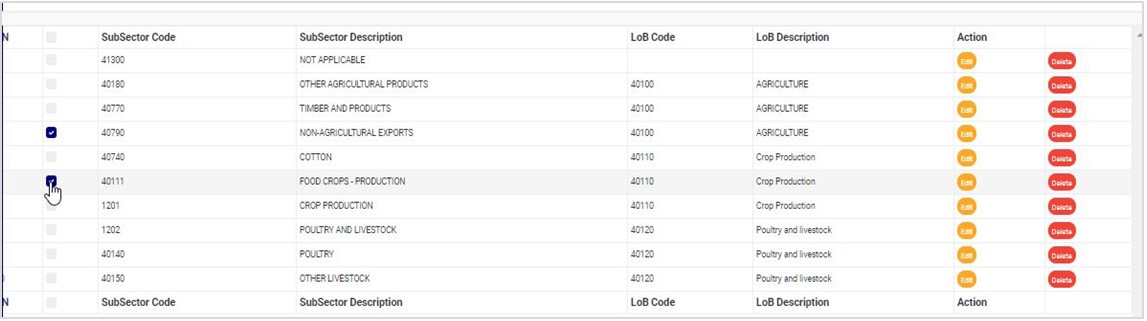
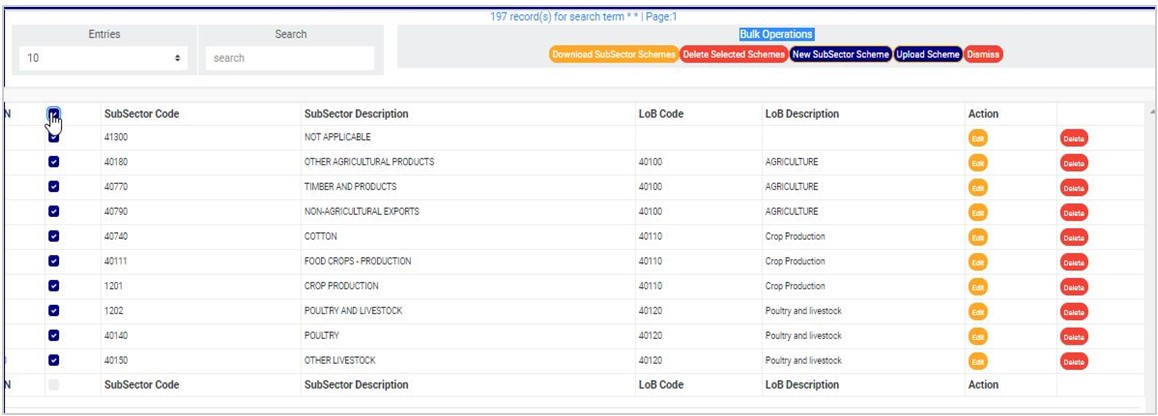
STEP 1: Select sub-sector schemes to be deleted by clicking on their checkboxes as shown in fig. 15.7a below.

(fig. 15.7a)

➔ To select/deselect all the schemes on a page, click on the checkbox on the table’s title bar. This checkbox is between ‘SN’ and ‘SubSector Code’. See fig. 15.7b below.

(fig. 15.7b)

STEP 2: Click on ‘DELETE SELECTED SCHEME’ as shown in fig. 15.7c below.

(fig. 15.7c)

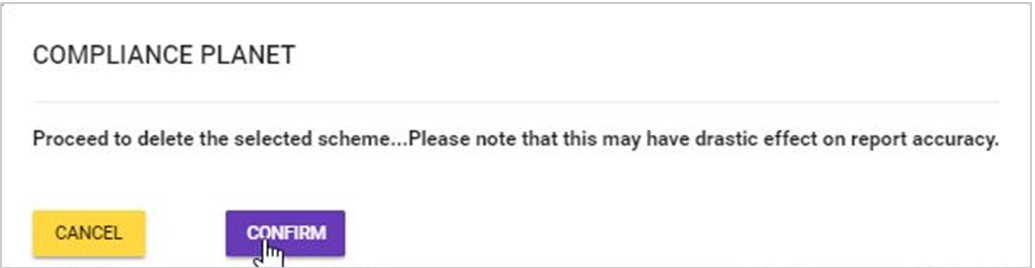
➔ Clicking on ‘Delete Selected Schemes displays a confirmation console as seen in fig. 15.7d below.

STEP 3: Click on ‘CONFIRM’ to proceed or ‘CANCEL’ to discontinue delete operation. See fig. 15.7d.

(fig. 15.7d)

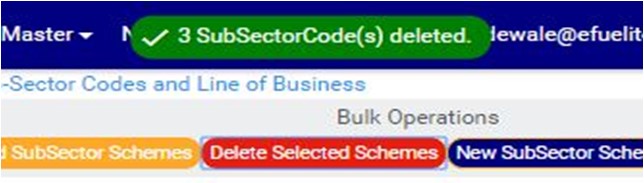
➔ If you proceed, a notification as in fig. 15.7e below will be displayed at the top of the page when delete operation is complete.

(fig. 15.7e)

How To Make Bulk Upload of New Sub-Sector Schemes

➔ To add more than one new account scheme on the software; you need to upload an excel file filled with the details of the new sub-sectpor schemes according to the software’s specification for uploading new sub-sector schemes. This process is described below.

STEP 1: Click on ‘UPLOAD SCHEME’ as in fig. 15.8a below.

(fig. 15.8a)

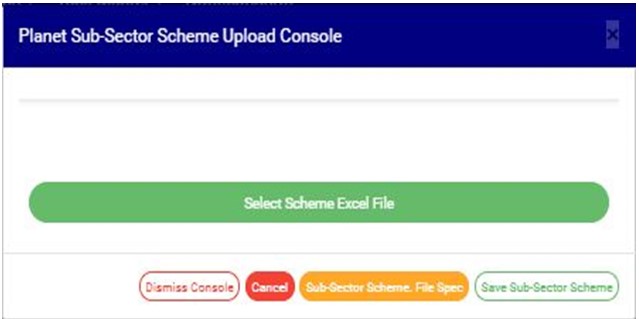
➔ This displays a ‘Planet Sub-Sector Scheme Upload’ console as in fig. 15.8b

(fig. 15.8b)

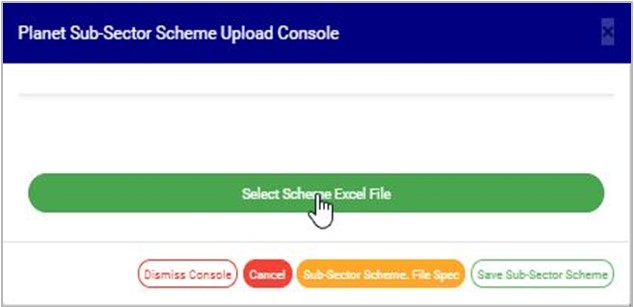
STEP 2: Click ‘SELECT SCHEME EXCEL FILE’ as in fig. 15.8c to choose the excel file filled with the details of the new sub-sector schemes to be uploaded on the planet.

(fig. 15.8c)

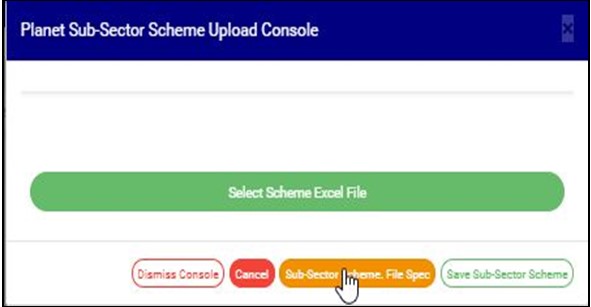
➔ If you do not have the file specification for uploading new sub-sector schemes, click on ‘SUB-SECTOR SCHEME FILE SPEC.’ as shown in fig. 15.8d below to download an excel file with the required specification.

(fig. 15.8d)

➔ An excel file will be downloaded to your computer with pre-filled titled columns under which the details will be entered. Open the file, fill in the required details of the new sub-sector schemes and save the changes to the file. Renaming the file on your computer is optional. Go back to the software and click on ‘Select Scheme Excel File’ to select the file.

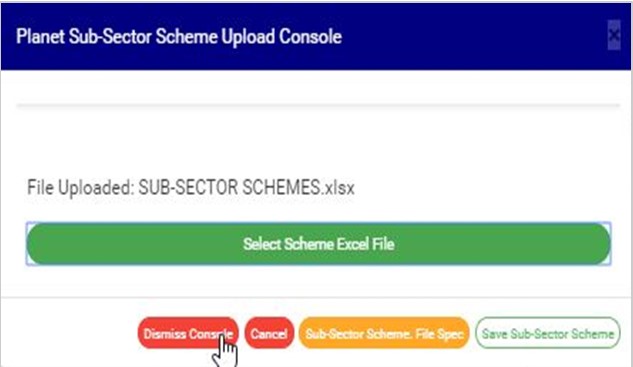
➔ After selecting a file from your computer, the name of the selected file will be added to the upload console. See fig. 15.8e below for an example.

(fig. 15.8e)

➔ To close the upload console, click on ‘DISMISS CONSOLE’ as in fig. 15.8f. You continue from where you stopped by clicking ‘Upload scheme’.

(fig. 15.8f)

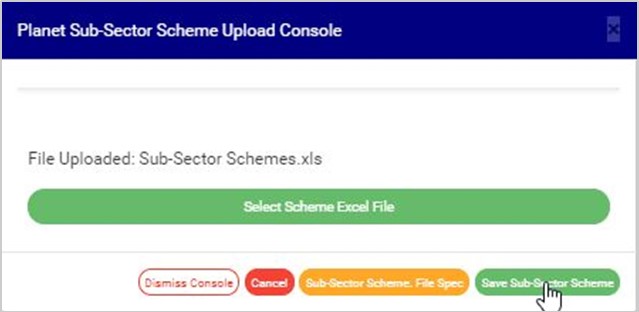
STEP 3: Click on ‘SAVE SUB-SECTOR SCHEME’ as in fig. 15.8g below to save the new sub-sector schemes on the planet.

(fig. 15.8g)

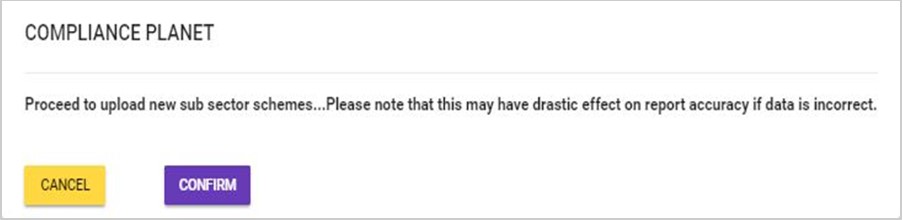
➔ This displays a confirmation console, Click on ‘CONFIRM’ to proceed or ‘CANCEL’ to return to the upload console. See fig. 15.8h.

(fig. 15.8h)

➔ A notification as in fig. 15.8i below will be displayed at the top of the page as the planet is saving the new sub-sector schemes.

(fig. 15.8i)

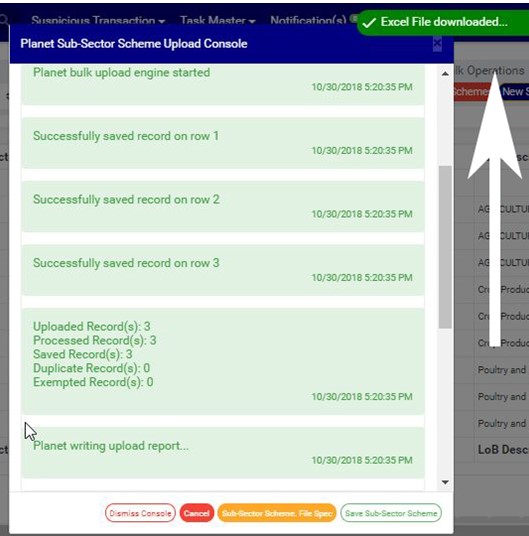
➔ The signal console shows on going processes. An example of a signal console is fig 6.5bb. When the upload is complete, an excel file titled, ‘Sub-sector Code Upload Report’ will be downloaded. You will be notified as shown in fig. 15.8j.

(fig. 15.8j)

For further enquiries :
Tel +234(0) 816 555 9818
Email solutions@efuelite.com

Overview Of Sub Sector Scheme In Compliance Planet Anti Money Laundering/Core Banking Finance Software

A Sub-sector scheme refers to a section of a customer sector tagged with a line of business. The compliance planet software through this sub-sector scheme feature maps each sub-sector of a customer sector with a line of business. During the process of opening an account, the occupation of the financial institution’s prospective customer determines which sector and sub-sector the customer’s account will be categorized into. In line with ADRAPS, each sub-sector is tagged with a line of business, which makes a sub-sector scheme. Thus, for each sub-sector scheme, there is a line of business code. So, during the processing of the various ADRAPS reports, the compliance planet software processes the sub-sector code and line of business code in order to place each account under a line of business in accordance with ADRAPS requirements.

● SubSector Code: This is a unique number that represents a sub-sector.

● SubSector Description: This refers to a customer sub-sector. A sub-sector is a subdivision of a group of customers classified based on related occupations.

● LoB Code: This is a unique number that represents a particular line of business. No two lines of business have the same LoB code. The

● LoB Description: This refers to the kind of product manufactured or service rendered by customer within a customer sub-sector. A line of business is a general term that describes the products or services offered by a business or manufacturer. Line of business is represented by LoB.:

SUB-SECTOR SCHEME OPERATIONS 
The operations pertaining to SUB-SECTOR SCHEME on the Compliance Planet are:

1. Editing a sub-sector scheme

2. Deleting a sub-sector scheme

3. Creating a new sub-sector scheme

4. Downloading all sub-sector schemes

5. Bulk delete of sub-sector schemes

6. Bulk upload of new sub-sector schemes

The last three (3) operations are for bulk operations.

For further enquiries : 
Tel +234(0) 816 555 9818
Email solutions@efuelite.com 
How To Carry Out Customer Sector-tier Operations In Compliance Planet Anti Money Laundering/Core Banking Finance Software

This control panel feature provides a list of customer sectors and their sub sector tier tags. The customer sector is a section in the AML/CFT RBS report. Here, the operations are;

● Editing a customer sector-subsector tier tag

● Deleting a customer sector-subsector tier tag, and

● Creating a customer sector-subsector tier tag

NOTE: Only Person(s) profiled as deputy supreme admin will be able to carry out this operation(s).

To perform any of the operations on Customer Sector- subsector tier tag;

STEP 1: From the main dashboard, click ‘CONTROL PANEL’ as shown in fig 14.2a below

(fig. 14.2a)

STEP 2: From the left hand side menu click ‘CUSTOMER SECTOR TIER’ as in fig. 14.2b below.

(fig. 14.2b)

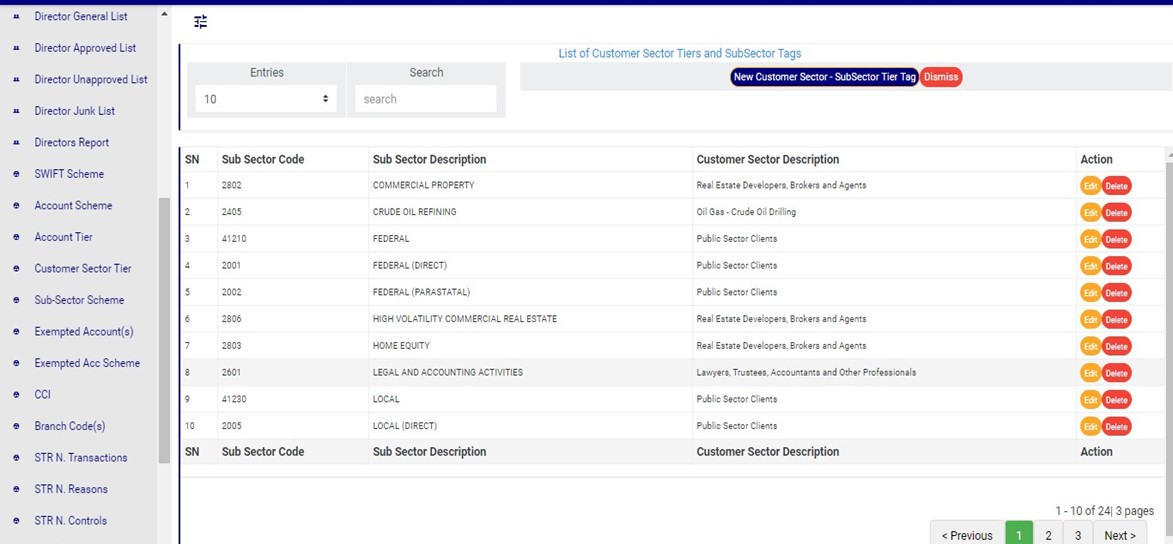
➔ This displays a page showing a list of all customer sectors and sub sectors in the institution, with options to edit, delete and create new information. As stated earlier, customer sector is also referred to as the ‘Customer Tier’. On the table provided on the customer sector tier page, it is represented with the Customer sector description on the table. See fig. 14.2c for an example.

(fig. 14.2c)

➔ As seen in fig. 14.2c, the bottom-right corner of the page, the planet gives information about the number of pages of the list, with the page numbers written out. The page numbers represent buttons to go to each page. By clicking on any of the page number, the software takes you to that particular page. Click on ‘NEXT’ to go to the next page or ‘PREVIOUS’ to go to the page before the one you are viewing at that moment.

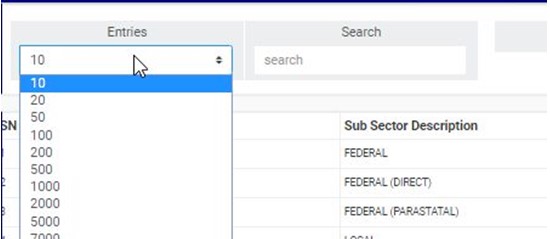
➔ Adjust the number of results per page by clicking on the ‘ENTRIES’ box as in fig. 14.2d.

(Fig. 14.2d)

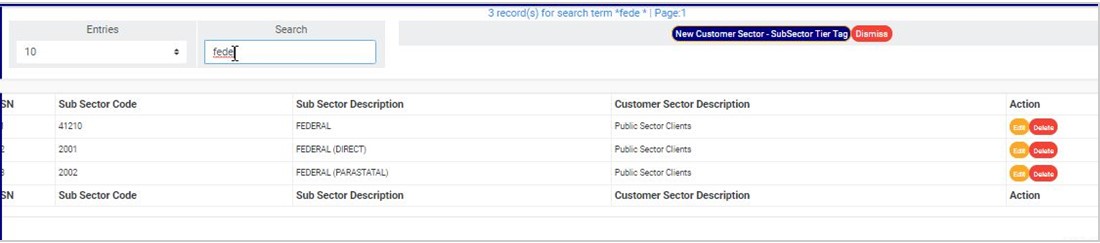
➔ Search for customer sectors and subsectors by inputting the sub sector code, sub sector description or customer sector description. Search results will appear immediately a character is typed in the search box.. See fig. 14.2e below for an example.

(fig. 14.2e)

➔ Each entry has two (2) action buttons; ‘Edit’ button and ‘Delete’ button and they are explained below.

How To Edit A Customer Sector Tier Tag
To change details of a customer sub-sector tier tag;

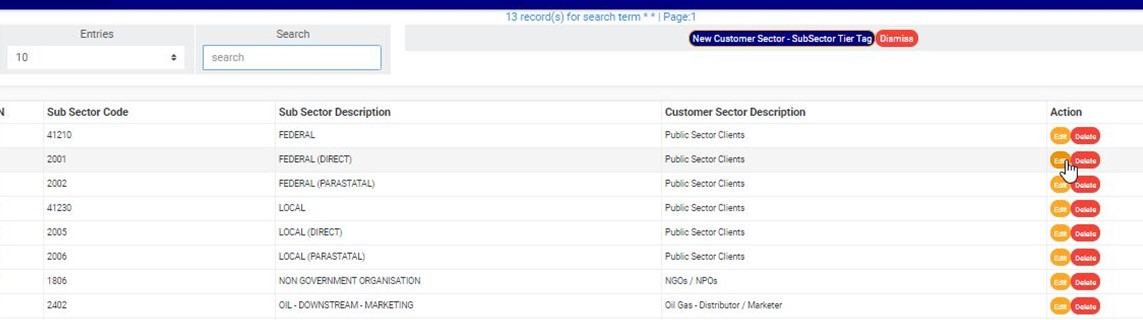
STEP 1: Click the ‘Edit’ button as shown in fig.14.3a below.

(fig. 14.3a)

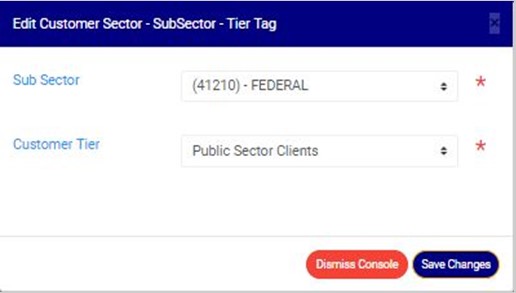
➔ This displays an ‘Edit Customer Sub Sector-Tier tag’ console, as in fig. 14.3b.

(fig. 14.3b)

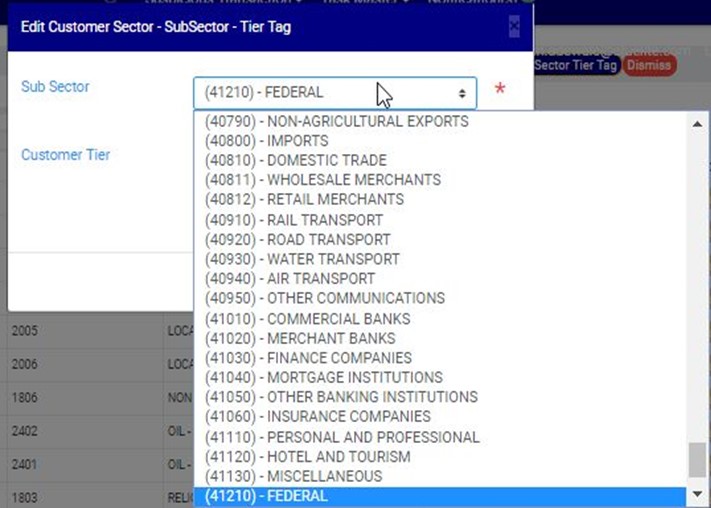
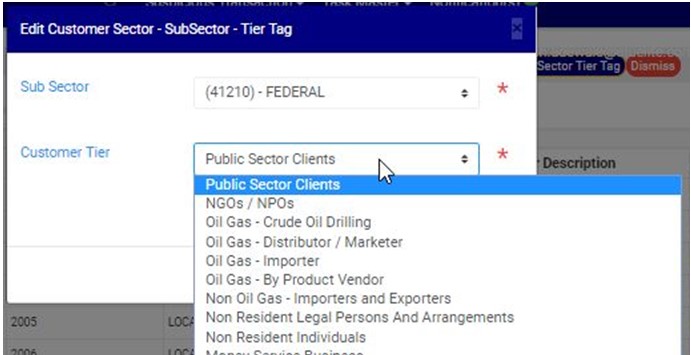
STEP 2: Select new options from the ‘Sector’ box and ‘Customer tier’ box as shown in fig. 14.3c and fig. 14.3d respectively.

(fig. 14.3c)

(fig. 14.3d)

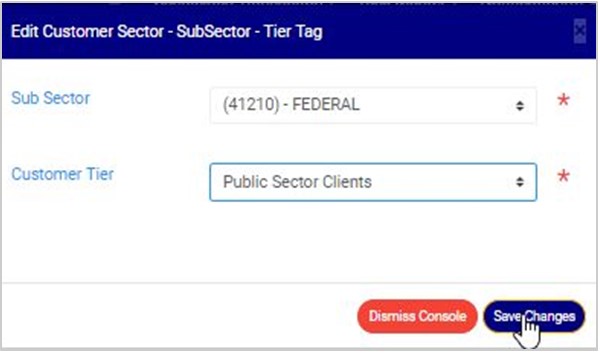
STEP 3: Click on ‘SAVE CHANGES’ as shown in fig. 14.3e below, to update the new changes on the planet.

(fig. 14.3e)

➔ This displays a confirmation console as in fig. 14.3f to confirm you want to change the details.

(fig. 14.3f)

➔ Click on ‘CONFIRM’ to save the changes or cancel to discontinue action. When the changes are saved, a notification will be displayed at the top of the page as in fig. 14.3g below.

(fig. 14.3g)

How to Delete Customer Sector Tier Tag
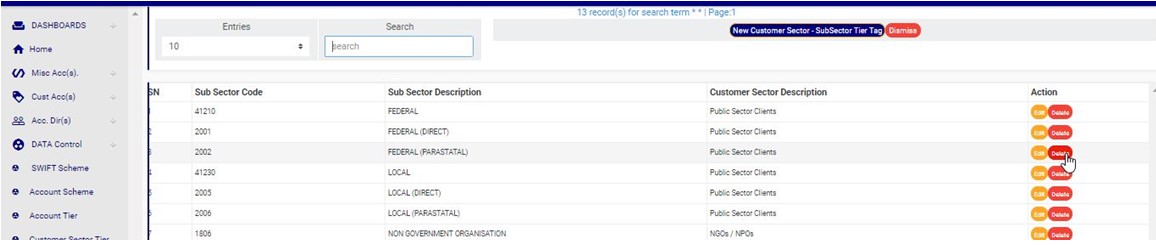
➔ To delete a customer sector-subsector-tier tag, click on the ‘DELETE’ button as shown in fig. 14.4a below.

(fig. 14.4a)

➔ This displays a confirmation console to confirm your request to delete the customer sector tier tag as in fig. 14.4b. Click on ‘CONFIRM’ to proceed or ‘CANCEL’ to discontinue.

(fig. 14.4b)

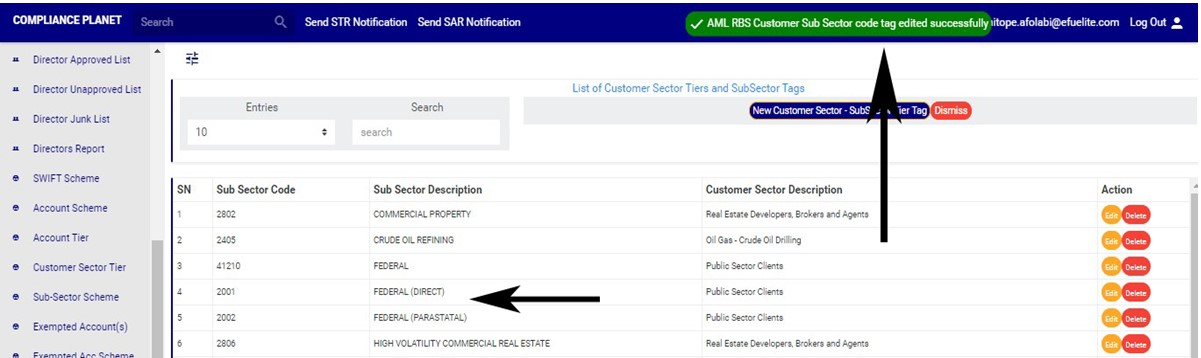
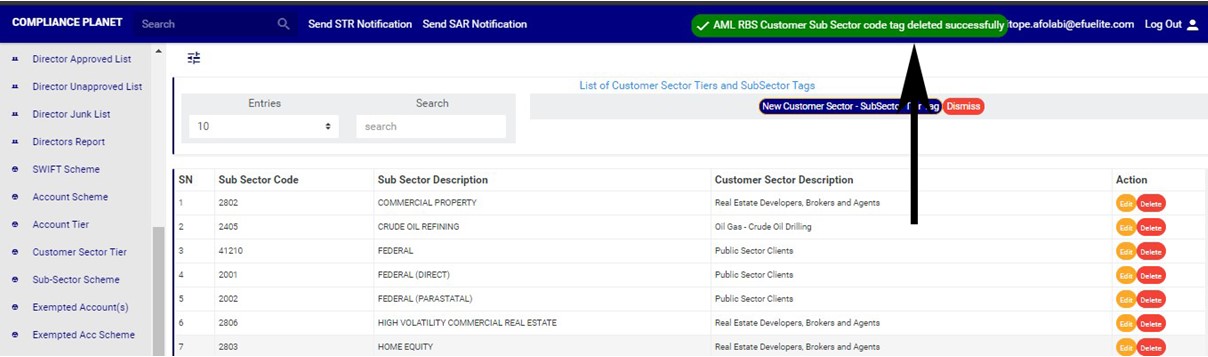
➔ When the operation is complete, a notification will appear at the top of the page as in fig. 14.4c.

(fig. 14.4c)

How To Create New Customer Tier Tag
➔ This refers to the adding of a new customer sector-subsector tier tag. Here is how to do this.

STEP 1: Click on ‘NEW CUSTOMER SECTOR-SUBSECTOR-TIER TAG’ as in fig. 14.5a below.

(fig. 14.5a)

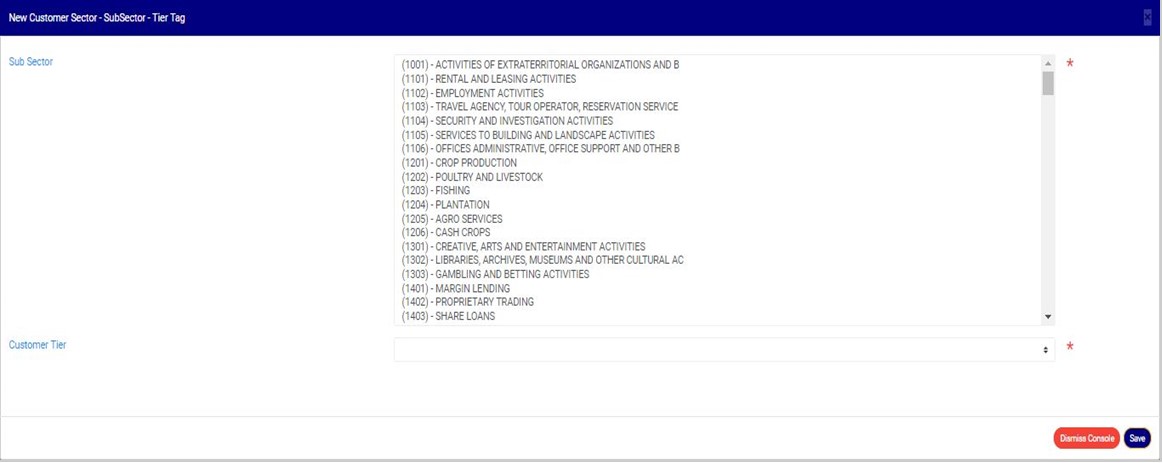
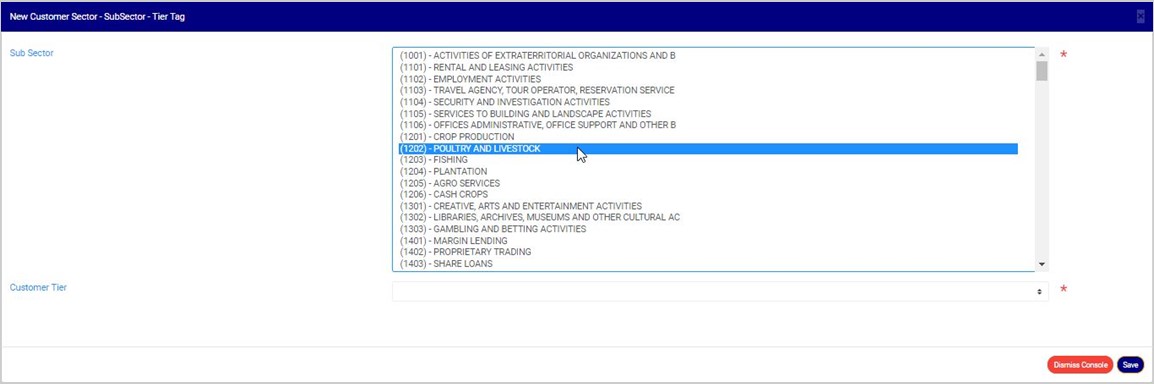
➔ This displays a ‘NEW CUSTOMER SECTOR-SUBSECTOR-TIER’ console. See fig. 14.5b below for an example.

(fig. 14.5b)

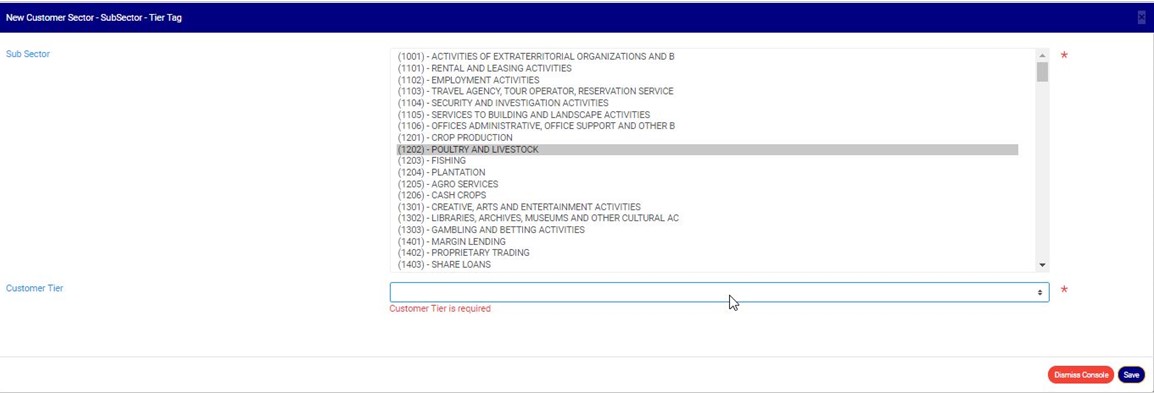
STEP 2: Select ‘Sub Sector’ and ‘Customer Tier’ as shown in fig. 14.5c and fig. 14.5d respectively.

(fig. 14.5c)

(fig. 14.5d)

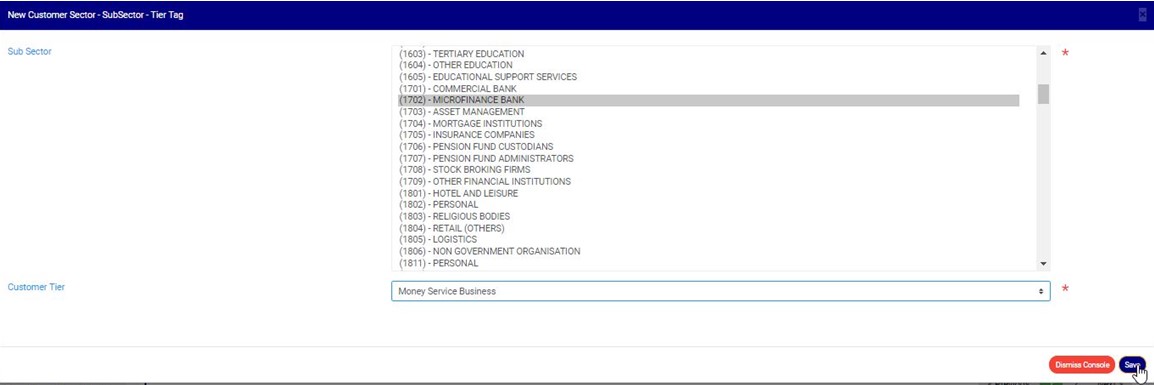
STEP 3: After selecting the details, click on ‘SAVE’ as shown in fig. 14.5e below.

(fig. 14.5e)

➔ This displays a confirmation console to confirm you want to add the new customer sector-subsector tier tag. Click on ‘CONFIRM’ to proceed or ‘CANCEL’ to discontinue.

(fig. 14.5f)

➔ If you proceed, a notification as in fig. 14.5g will appear at the top of the page when the new customer sector-tier tag has been successfully created.

(fig. 14.5g)

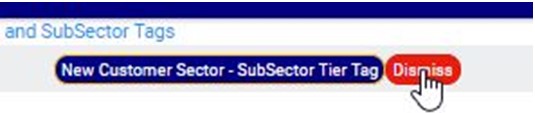
● ‘DISMISS’ BUTTON

The ‘DISMISS’ button is used for closing the CUSTOMER SECTOR TIER page. Clicking on this button will also close the current page and take you back to the Control panel home page. See this button in fig. 14.5h below.

(fig. 14.5h)

For further enquiries :
Tel +234(0) 816 555 9818
Email solutions@efuelite.com

Web http://solutions.efuelite.com

Overview Of Customer Sector-tier In Compliance Planet Anti Money Laundering/Core Banking Finance Software

This section provides a guide on how to perform operations pertaining to CUSTOMER SECTOR TIERS on the Planet, with step-by-step instructions and pictures.

customer sector refers to a segment or group of customers classified based on similar characteristics in specific ways such as ownership, industry, occupation, etc. Customer sub sectors are further classifications of customer sector indicating the different sections of a sector having a specific characteristic. An example of a customer sector is public sector and sub-sectors of the public sector include federal government, state government, local government, etc.

During the process of opening an account, the occupation of the financial institution’s prospective customer determines which sector and sub-sector the customer’s account will be categorized into. Each customer sub-sector has a code referred to as ‘Sub-sector code’. On the compliance planet, customer sector is also referred to as the ‘Customer Tier’

CUSTOMER SECTOR TIER OPERATIONS 

This data control feature provides a list of customer sectors and their sub sector tier tags. The customer sector is a section in the AML/CFT RBS report. Here, the operations are;

● Editing a customer sector-subsector tier tag

● Deleting a customer sector-subsector tier tag, and

● Creating a customer sector-subsector tier tag

For further enquiries : 
Tel +234(0) 816 555 9818
Email solutions@efuelite.com 
Web http://solutions.efuelite.com

Overview Of Account Tiers In Compliance Planet Anti Money Laundering/Core Banking Finance Software

In line with the Three-Tiered KYC requirements issued by the CBN, account schemes are classified into the three tiers of account. Account tier refers to the three levels of account; Tier One Account, Tier Two Account and Tier Three Account. Account scheme tier tag refers to the particular class or level (tier) of account an account scheme belongs to. Tier tags are represented by their tag description.

Account Tier Operations

This Control panel feature provides a list of account scheme-tier tags. The operations include;

● Editing an account scheme tier,

● Deleting an account scheme tier, and

● Creating a new account scheme tier tag.

For further enquiries :
Tel +234(0) 816 555 9818
Email solutions@efuelite.com
Web http://solutions.efuelite.com

How To Carry Out Account Tier Operations In Compliance Planet Anti Money Laundering/Core Banking Finance Software

This Control panel feature provides a list of account scheme-tier tags. The operations include;

● Editing an account scheme tier,

● Deleting an account scheme tier, and

● Creating a new account scheme tier tag.

NOTE: Only Person(s) profiled as deputy supreme admin will be able to carry out this operation(s).

To perform any of the operations on ACCOUNT SCHEME-TIER TAGS;

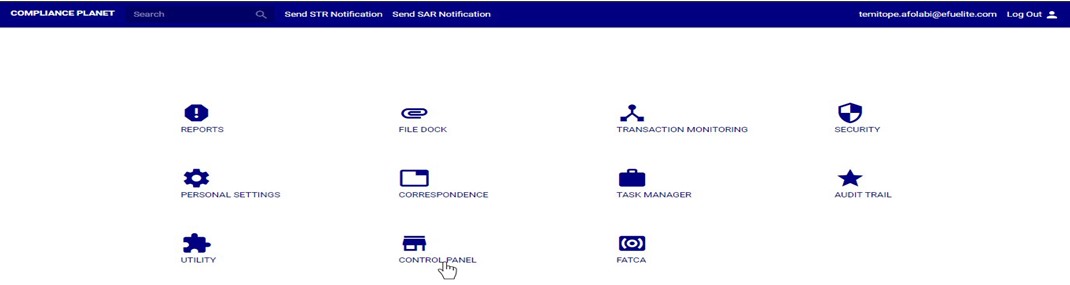
STEP 1: From the main dashboard, click ‘CONTROL PANEL’ as in fig 13.2a below

(fig. 13.2a)

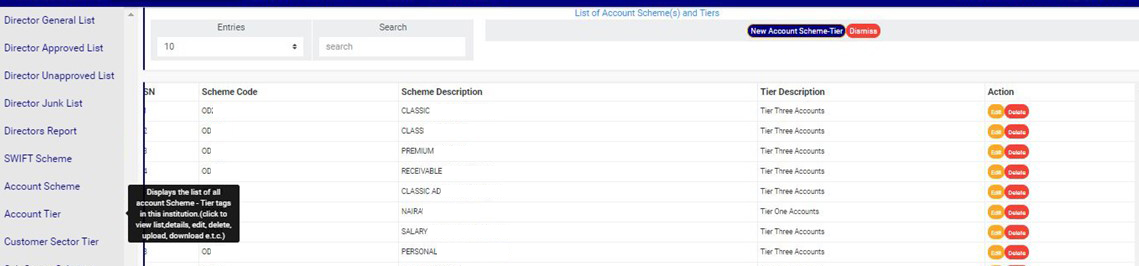
STEP 2: From the left hand side menu, click on ‘ACCOUNT TIER’ as in fig. 13.2b below.

(fig. 13.2b)

➔ This displays a page showing a list of all account schemes and their tier tags. See fig. 13.2c for an example.

(fig. 13.2c)

➔ From fig. 13.2c above, at the bottom-right corner of the page, the software gives information about the number of pages of the list, with the page numbers written out. The page numbers represent buttons to go to each page. By clicking on any of the page number, the planet takes you to that particular page. Click ‘NEXT’ to go to the next page or ‘PREVIOUS’ to go to the page before the current page.

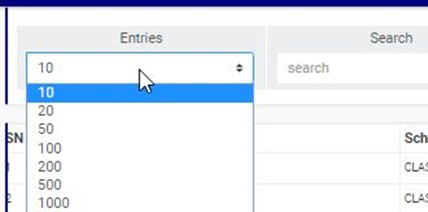
➔ Adjust the number of account scheme tier tags per page by clicking on the ‘ENTRIES’ box. See fig. 13.2d for an example.

(fig. 13.2d)

➔ Search for Account Schemes and their tier tags by typing the scheme code, scheme description or tier description. Search results will be shown immediately a character is typed in the search box. See fig. 13.2e below for an example.

(fig. 13.2e)

➔ Each entry has two (2) action buttons; ‘Edit’ button and ‘Delete’ button. The operations are explained below.

How To Edit an Account Tier

To change details of an account scheme-tier tag;

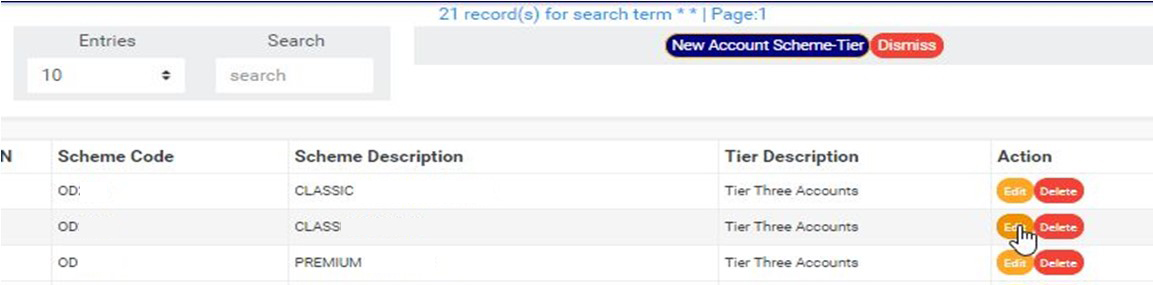
STEP 1: Click on the ‘Edit’ button as shown in fig.13.3a below.

(fig. 13.3a)

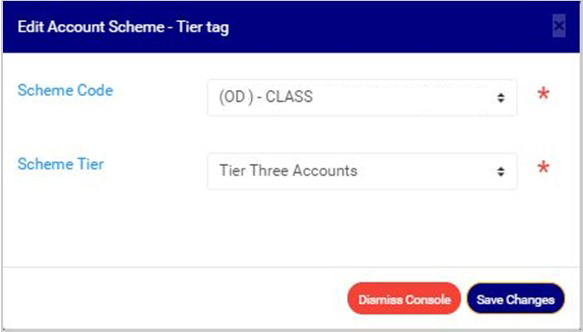
➔ This displays an ‘Edit Account Scheme-Tier tag’ console, as in fig. 13.3b.

(fig. 13.3b)

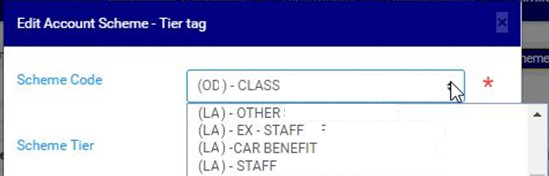
STEP 2: Select a scheme code and/or a scheme tier as in fig. 13.3c and fig. 13.3d respectively, depending on what you want to edit.

(fig. 13.3c)

(fig. 13.3d)

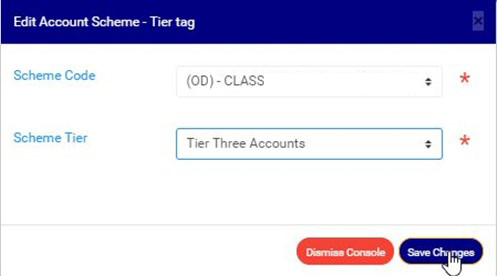
STEP 3: Click ‘SAVE CHANGES’ as shown in fig. 13.3e below, to update the new changes on the planet.

(fig. 13.3e)

➔ This displays a confirmation console as in fig. 13.3f to confirm you want to change the details.

(fig. 13.3f)

➔ Click on ‘CONFIRM’ as in fig. 13.3f above to save the changes or CANCEL to discontinue action. When the changes are saved, a notification will be displayed at the top of the page as in fig. 13.3g below.

(fig. 13.3g)

How To Delete an Account Tier

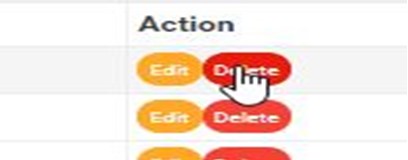
➔ To delete an account scheme-tier tag, click on ‘DELETE’ as in fig. 13.4a below.

(fig. 13.4a)

➔ This displays a confirmation console to confirm your request to delete the account scheme-tier tag as in fig. 13.4b. Click on ‘CONFIRM’ to proceed or ‘CANCEL’ to discontinue.

(fig. 13.4b)

➔ A notification as in fig. 13.4c will also be displayed at the top of the page when scheme-tier tag delete is complete.

(fig. 13.4c)

How To Create New Account Scheme-Tier Tag

➔ This refers to the adding of a new account scheme-tier tag. Here is how to do this.

STEP 1: Click on ‘NEW ACCOUNT SCHEME-TIER’ as in fig. 13.5a below.

(fig. 13.5a)

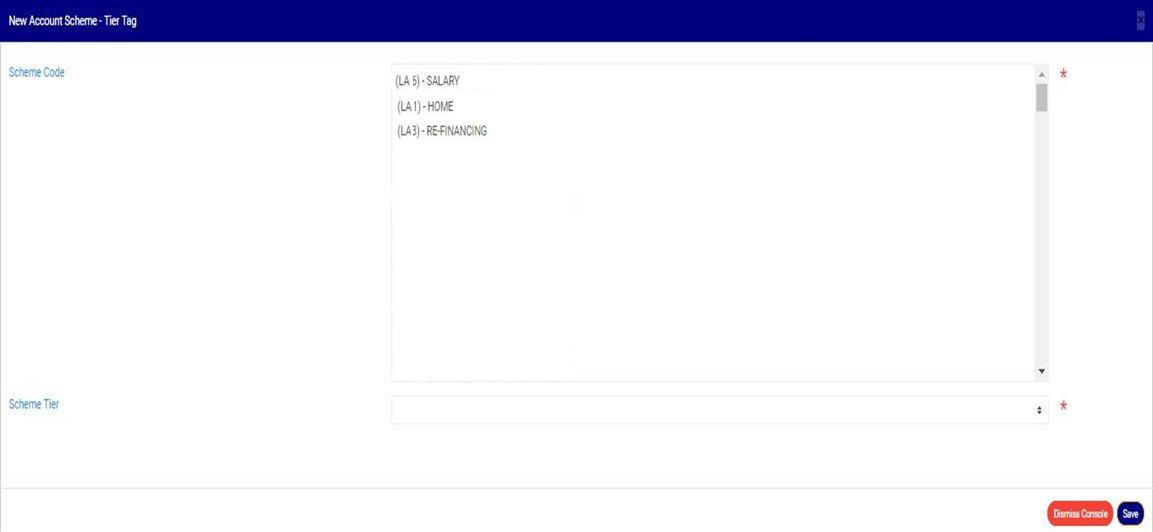
➔ Clicking on ‘NEW ACCOUNT SCHEME-TIER’ will display a console titled, ‘NEW ACCOUNT SCHEME-TIER TAG’, on which you are to select details of the scheme. See fig. 13.5b below for an example.

(fig. 13.5b)

➔ Select account scheme code from the list of scheme codes as seen in fig. 13.5c for an example.

(fig. 13.5c)

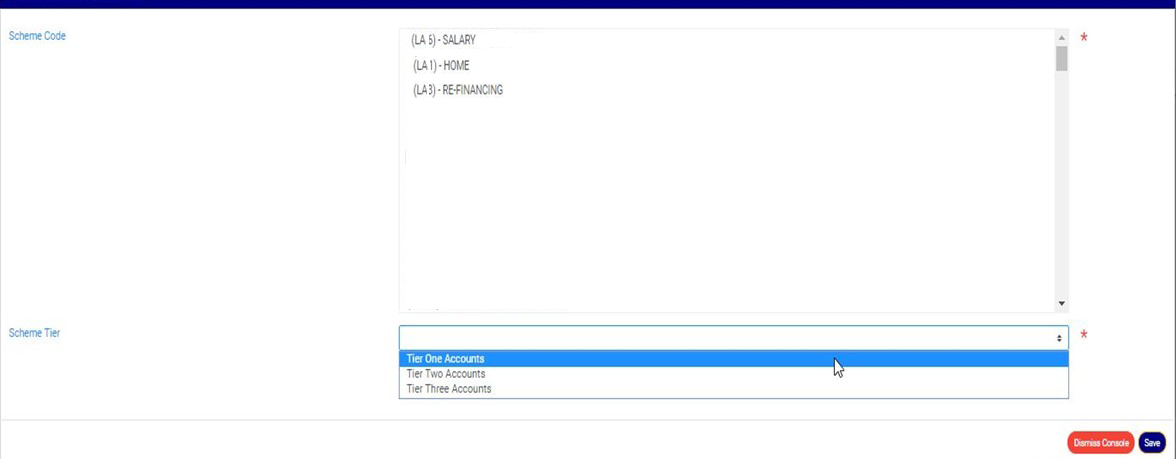
➔ Select scheme-tier tag as shown in fig. 13.5d below.

(fig. 13.5d)

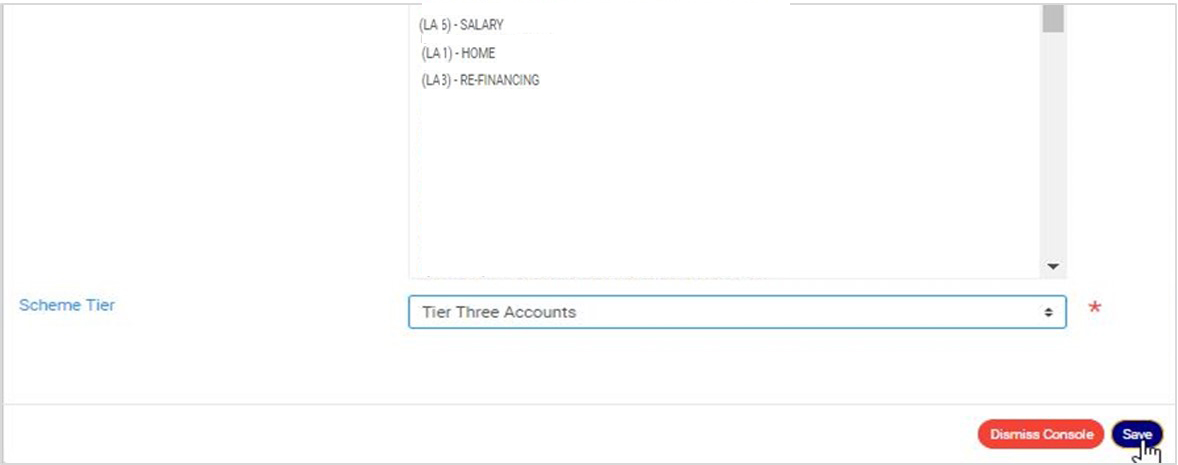
STEP 2: Click ‘SAVE’ as shown in fig. 13.5e below to add the new scheme tier-tag.

(fig. 13.5e)

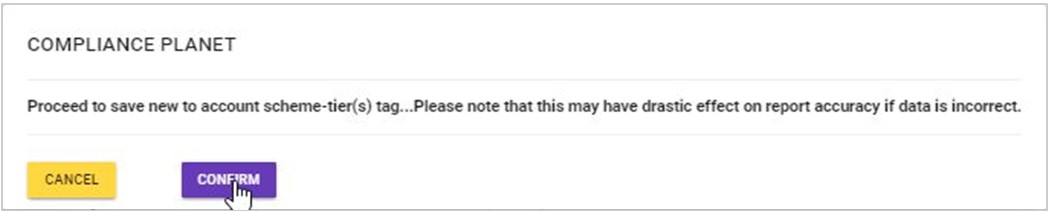
➔ This displays a confirmation console as in fig. 13.5f below. Click on ‘CONFIRM’ to proceed with the creation of a new account scheme tier tag or ‘CANCEL’ to discontinue.

(fig. 13.5f)

➔ If you proceed, a notification as in fig. 13.5g will be displayed at the top of the page when the account scheme-tier tag is successfully created.

(Fig. 13.5g)

● ‘DISMISS’ BUTTON

The ‘DISMISS’ button is used for closing the ACCOUNT TIER page also. Clicking on this button will close the current page and take you to the Data panel home page. See this button in fig. 13.5h below.

(fig. 13.5h)

For further enquiries :
Tel +234(0) 816 555 9818
Email solutions@efuelite.com

Web http://solutions.efuelite.com

How To Carry out Account Scheme Operations In Compliance Planet Anti Money Laundering/Core Banking Finance Software

Under this control panel feature, the software provides a list of account schemes a financial institution has and operations that can be carried out on the account schemes. These operations include editing, deleting, downloading and adding new account schemes, with options to carry out operations individually or in bulk.

Note: Only person(s) profiled as deputy supreme admin can carry out account scheme operations.

To perform any of the operations on Account schemes;

STEP 1: From the main dashboard, click ‘CONTROL PANEL’ as in fig 12.2a below

(fig. 12.2a)

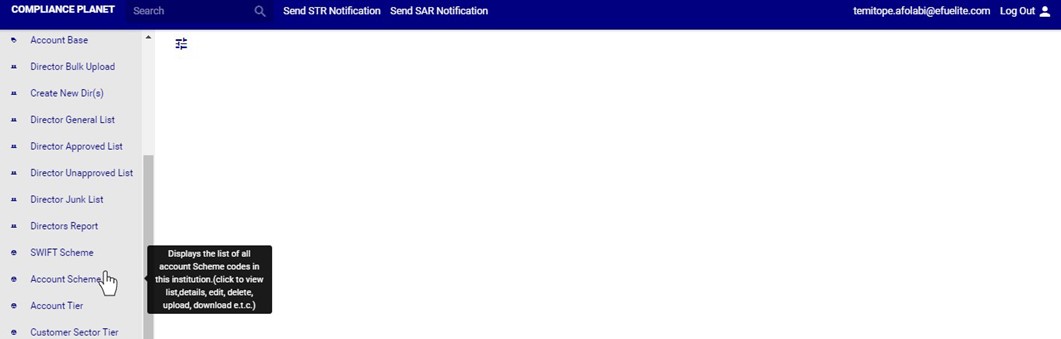
➔ STEP 2: From the left hand side menu, Click ‘ACCOUNT SCHEME’ as in fig. 12.2b below.

(fig. 12.2b)

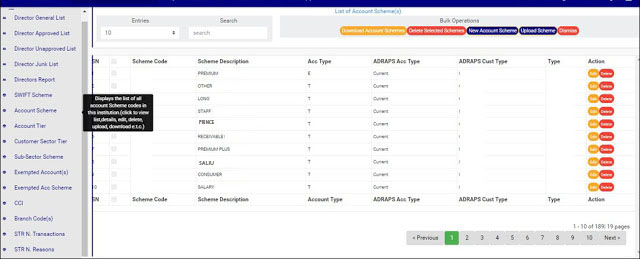
➔ This displays a page showing a list of all the financial institution’s account schemes. An account scheme comprise of a scheme code, an account type, an ADRAPS account type, an ADRAPS customer type and type. See fig. 12.2c for an example.

● Account type is an alphabetic representation of each account scheme in line with the provided schema description by NFIU.

● ADRAPS account type: This is the specification of an account type in line with ADRAPS requirements. ADRAPS account type can either be ‘Current’, ‘Savings’ or ‘Deposit’.

● ADRAPS customer type: This refers to the various types of customer account types in accordance to CBN ADRAPS template/schema description file. The customer types are; Individual, Estate, Joint account, Corporate, Government, Association, N.G.O., Embassy, International agency, Government and ‘Others’.

● Type: This represents the financial institution’s classification of the account sub-package.


(fig. 12.2c)

➔ As seen in fig. 12.2c above, at the bottom-right corner of the page, the planet gives information about the number of pages of the list, with the page numbers written out. Click on any page number,  and the software takes you to that particular page. Click on the ‘NEXT’ button to go to the next page or the ‘PREVIOUS’ button to go to the page before the current one.

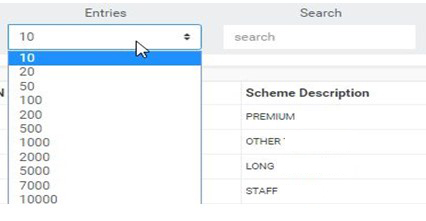
➔ Click on the ‘ENTRIES’ box to adjust the number of account schemes you see per page. See how to adjust the number of entries per page in fig. 12.2d.

(Fig. 12.2d)

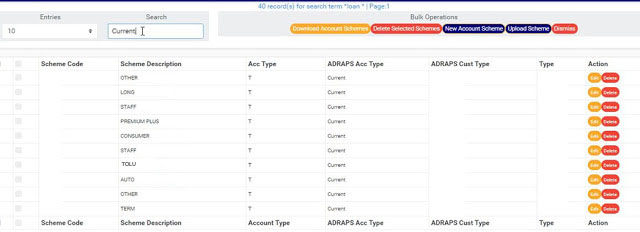
➔ Search for Account Schemes by typing the account scheme code, scheme description, account type, ADRAPS account type or ADRAPS customer type in the search box as in fig. 12.2e below. Search results will appear immediately a character is typed in the search box..

(fig. 12.2e)

➔ Each Account scheme has two (2) action buttons; ‘Edit’ button and ‘Delete’ button. The different operations are explained below.

How to edit an Account Scheme

➔ To change details of an account scheme;

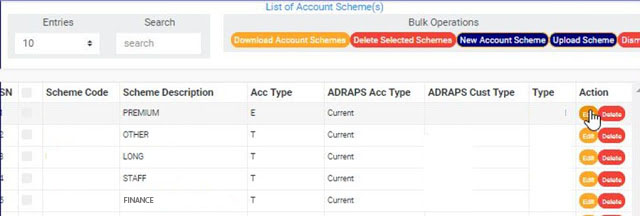
STEP 1 Click on its ‘Edit’ button as shown in fig. 12.2f below.

(fig. 12.2f)

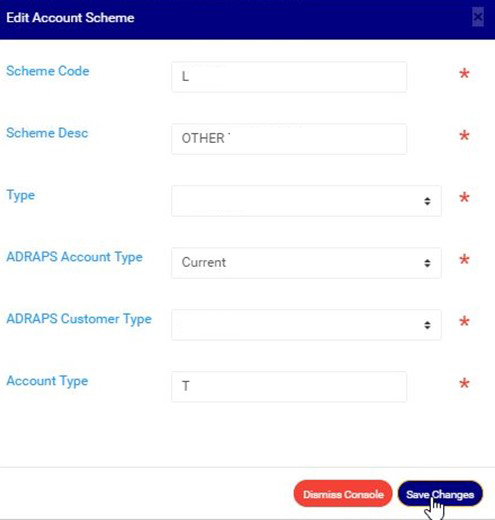
➔ This displays an ‘Edit Account Scheme’ console, as in fig. 12.2g.

(fig. 12.2g)

STEP 2: Fill in the details you want to add or change.

STEP 3: Click on ‘SAVE CHANGES’ as shown in fig. 12.2g above, to update the account scheme details on the planet.This displays a confirmation console as in fig. 12.2h to confirm you want to change the details.

(fig. 12.2h)

➔ Click ‘CONFIRM’ as in fig. 12.2h above to save the changes or cancel to discontinue action. When the changes are saved, a notification will be displayed at the top of the screen as in fig. 12.2i.

(fig. 12.2i)

How to Delete an Account Scheme

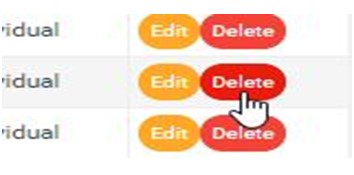
➔ To delete an account scheme, click on ‘DELETE’ as in fig. 12.2j .

(fig. 12.2j)

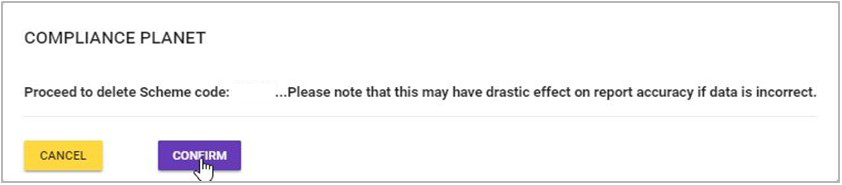
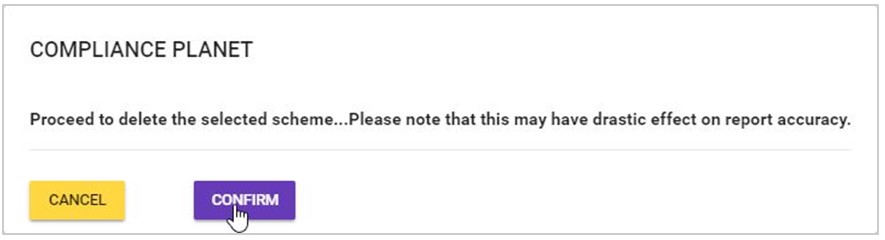
➔ This displays a confirmation console to confirm your request to delete that particular account scheme as in fig. 12.2k

(fig. 12.2k)

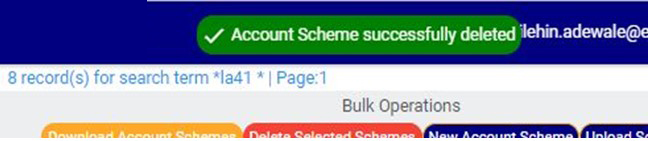
➔ Click on ‘CONFIRM’ to proceed. A notification as shown in fig. 12.2l will also be displayed at the top of your screen.

(fig. 12.2l)

How to carry out Bulk Account Scheme Operations

The action buttons available under the bulk operations section of the Account Scheme page as shown in fig. 12.2m include buttons for individual and bulk operations. They are;

● Download account schemes

● Delete selected schemes

● New account scheme

● Upload scheme

● Dismiss

(fig. 12.2m)

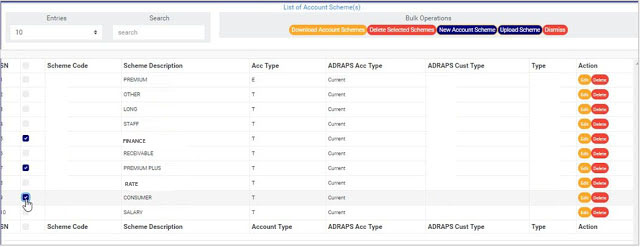
➔ To select an account scheme, click on its checkbox as shown in fig. 12.2n below. multiple account schemes can be selected for bulk operation as seen in the example.

(fig. 12.2n)

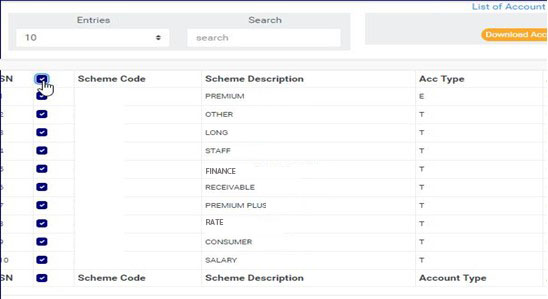
To select or deselect all the account schemes on a page, click on the checkbox of the table title bar as in fig. 12.2o. This checkbox is between SN and Scheme Code.

(fig. 12.2o)

A. How to Download Account Schemes

➔ To download all the financial institution’s account schemes on the planet, click on ‘DOWNLOAD ACCOUNT SCHEMES’ as in fig. 12.2p.

NOTE: you do not  need to select the account schemes.

(fig. 12.2p)

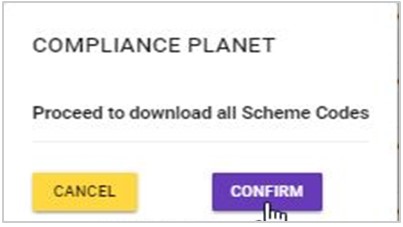
➔ This displays a confirmation console to confirm you want to download all the account schemes. Click on ‘CONFIRM’ as in fig. 12.2q to proceed with the download or ‘CANCEL’ to stop action.

(fig. 12.2q)

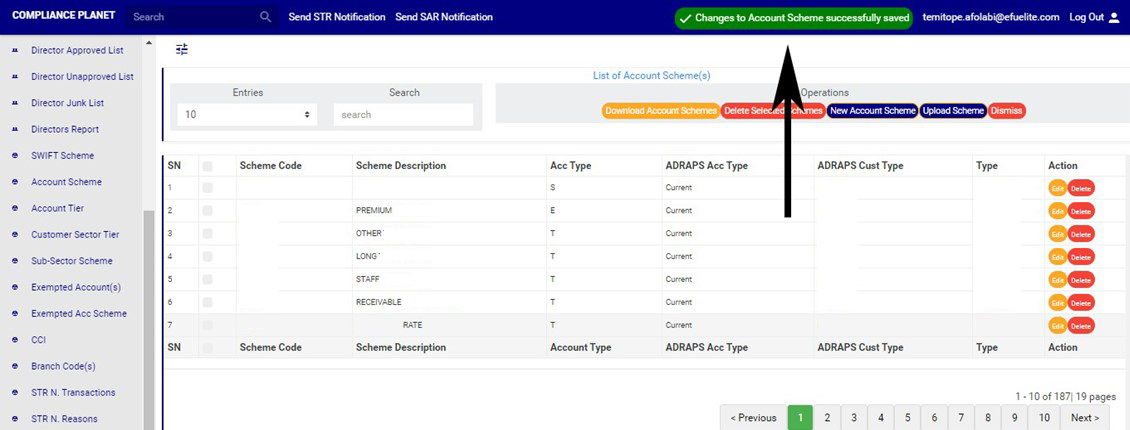
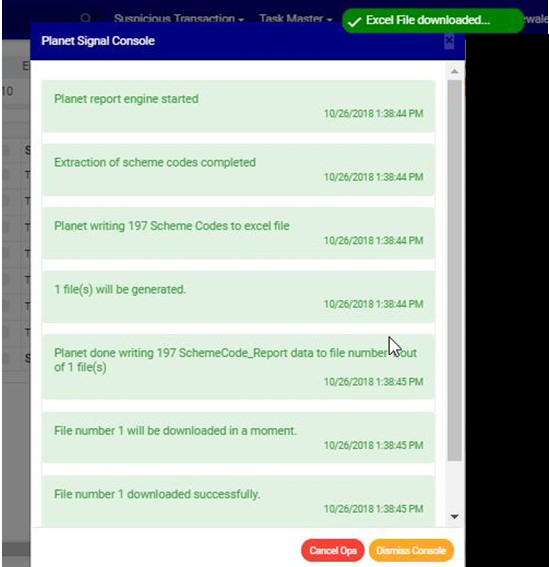
➔The signal console shows on going processes. An example of a signal console is fig 12.2r , and when download is complete, a notification will be displayed at the top of the page as shown in fig. 12.2r.

(fig. 12.2r)

B. How to delete Account schemes

➔ After selecting the account schemes to be deleted; Click on ‘DELETE SELECTED SCHEMES’ as in fig. 12.2s below


(fig. 12.2s)

➔ This displays a confirmation console to confirm your request as shown in fig. 12.2t below.


(fig. 12.2t)

➔ When the operation is complete, a notification will be displayed at the top of the page as in fig. 12.2u.

(fig. 12.2u)

C. How To Create New Account Scheme

➔ To add a new account scheme on the planet, click on ‘NEW ACCOUNT SCHEME’ as in fig. 12.2v below.

(fig. 12.2v)

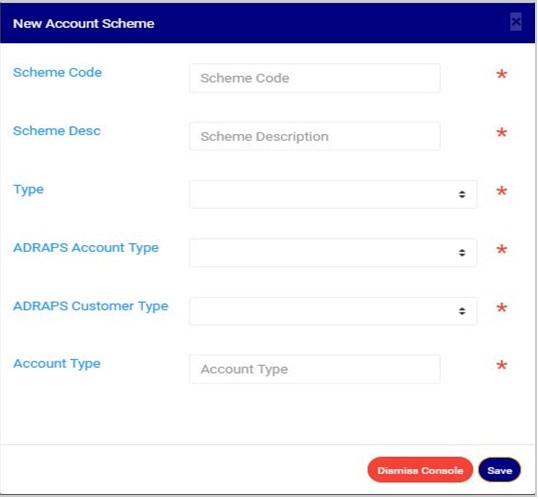
➔ This displays a console titled, ‘NEW ACCOUNT SCHEME’., where you are to input the details of the new scheme. See fig. 12.2w for an example.

(fig. 12.2w)

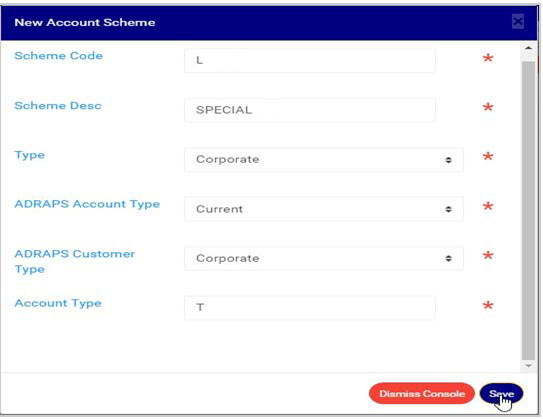
➔ Fill in the details of the new account scheme in their respective fields. See fig. 12.2x for an example. After inputting the details, click on ‘SAVE’ as shown below.

(Fig. 12.2x)

➔ This displays a confirmation console to confirm you want to add a new account scheme as in fig. 12.2y. Click on ‘CONFIRM’ to proceed with the creation of a new Account scheme or ‘CANCEL’ to discontinue.

(fig. 12.2y)

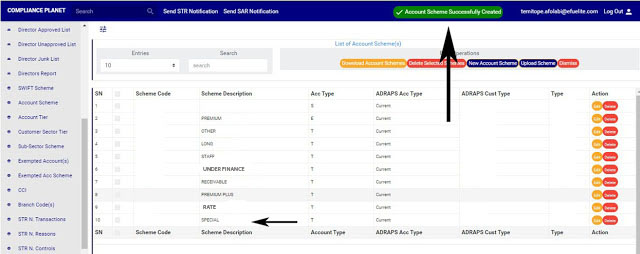
➔ If you proceed, a notification as in fig. 12.2z will be displayed at the top of the page when the account scheme has been successfully created. The new scheme would be added to the list of Account schemes on software.


(fig. 12.2z)

D. How To Make Bulk Upload of New Account Schemes.

➔ To add more than one new Account scheme on the software, you need to upload an excel file filled with the details of the new Account schemes according to the software’s specification for uploading new Account schemes. This process is described below.

STEP 1: Click on ‘UPLOAD SCHEME’ as in fig. 12.2aa below.

(fig. 12.2aa)

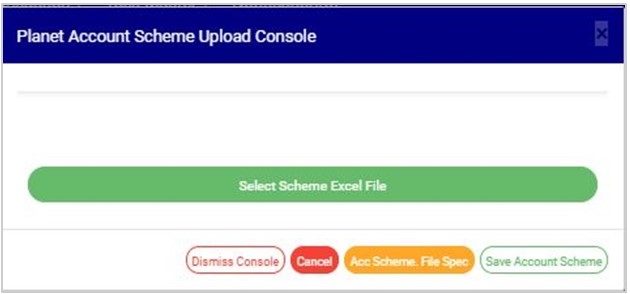
➔ This displays a ‘Planet Account Scheme Upload’ console as in fig. 12.2ab.

(fig. 12.2ab)

STEP 2: Click on ‘SELECT SCHEME EXCEL FILE’ as in fig. 12.2ac to choose the excel file filled with the details of the new account schemes to be uploaded on the software.

 (fig. 12.2ac)

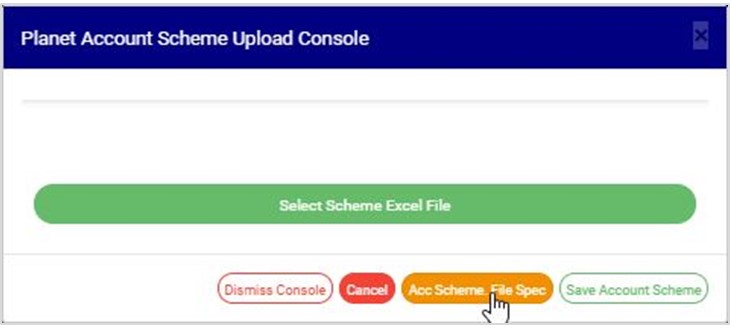
➔ If you do not have the file specification for uploading new details, click on ‘ACC. SCHEME FILE SPEC.’ as shown in fig. 12.2ad to download an excel file with the required specification.

(fig. 12.2ad)

➔An excel file will be downloaded to your computer with pre-filled titled columns under which the details will be entered. Open the file, fill in the required details of the new Account schemes and save the changes to the file. Renaming the file on your computer is optional. Now that you have a file to upload, click on ‘Select Scheme Excel File’ to choose that file for upload.

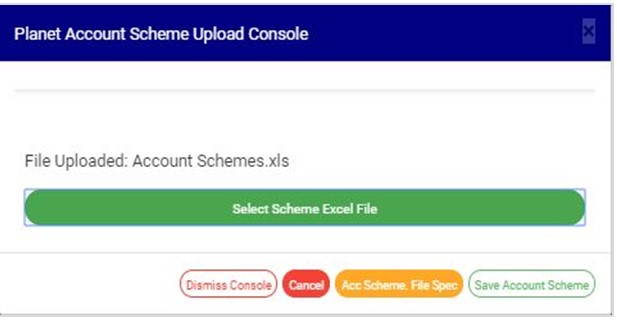
➔ After selecting a file from your computer, the name of the selected file will be added to the upload console. See fig. 12.2ae for an example.

(fig. 12.2ae)

➔ To close the upload console, click on ‘DISMISS CONSOLE’. Note that you can continue the upload from where you stopped by clicking ‘Upload scheme’.

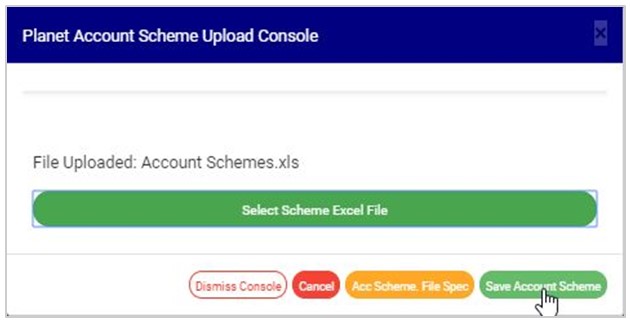
STEP 3: Click on the ‘SAVE ACCOUNT SCHEME’ button as in fig. 12.2af to save the new account schemes on the software.

(fig. 12.2af)

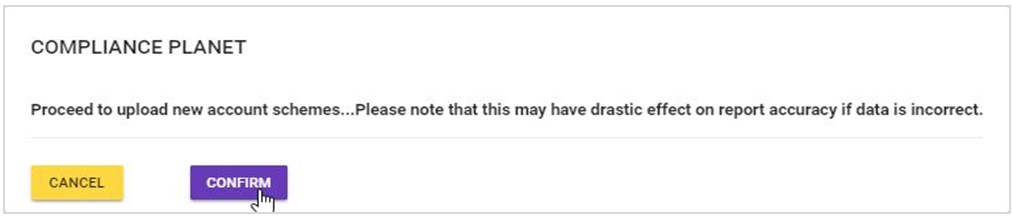
➔ This displays a confirmation console as in Fig 12.2ag below. Click on ‘CONFIRM’ to proceed or ‘CANCEL’ to return to the upload console.

(fig. 12.2ag)

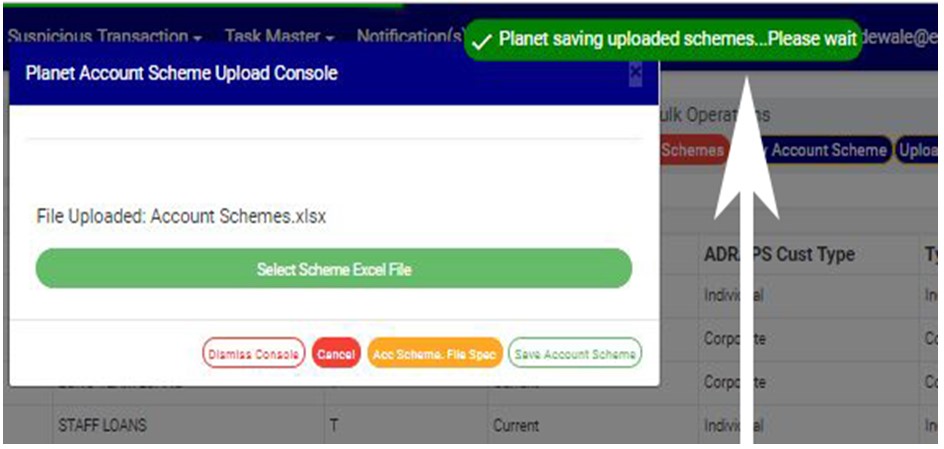
➔ A notification as in fig. 12.2ah below will be displayed at the top of the page as the planet is saving the new account schemes.

(fig. 12.2ah)

● ‘DISMISS’ BUTTON

Clicking on this button as in fig. 12.2aI below will close the page and take you to the DATA panel home page as in fig. 12.2a.

(fig. 12.2ai)

For further enquiries :
Tel +234(0) 816 555 9818
Email solutions@efuelite.com
Web http://solutions.efuelite.com

How to carry out Swift Scheme Operations In Compliance Planet Anti Money Laundering/Core Banking Finance Software

Under this control panel feature, the software provides a list of financial institutions and their SWIFT codes. Operations include editing, deleting, downloading and adding new SWIFT codes, with options to carry out operations individually or in bulk.

NOTE: Only person(s) profiled as deputy supreme Admin and assigned right(s) to “view Swift Dom transactions” will be able to carryout this operation.

To perform any of the operations on SWIFT schemes;

STEP 1: From the main dashboard, click on ‘CONTROL PANEL’  as in fig 11.2a below

(fig. 11.2a)

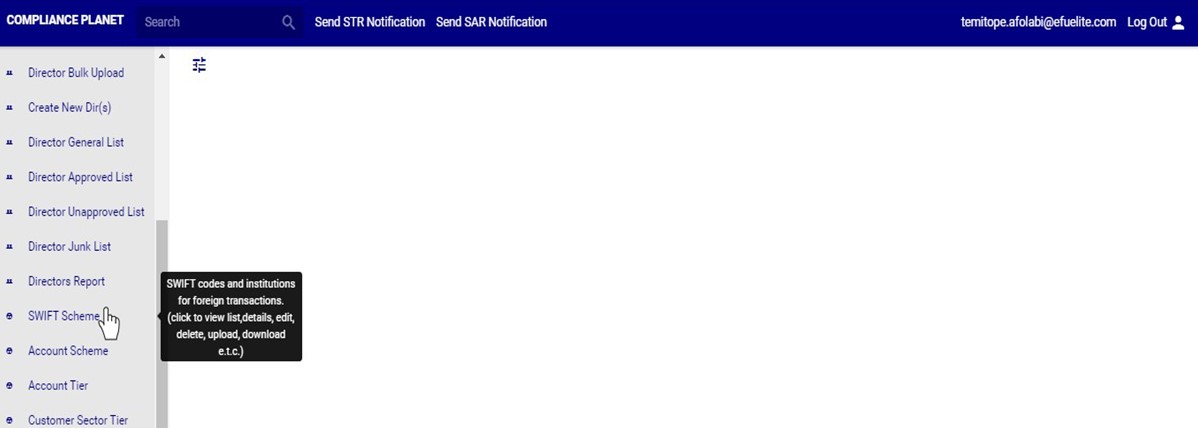
➔From the left hand side menu, click on ”Swift Scheme” as shown I Fig 11.2b below.

(fig. 11.2b)

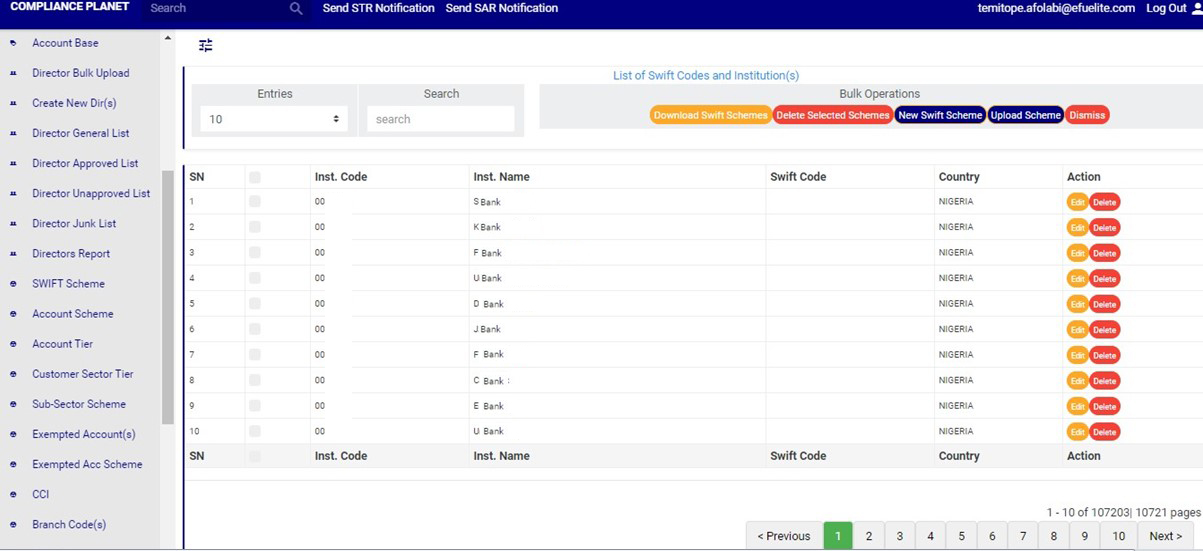
STEP 2: This displays a page showing a list of all financial institutions, their SWIFT codes and other details. See fig. 11.2c for an example.

(fig. 11.2c)

➔ At the bottom-right corner of the page, the software gives information about the number of pages on the list, with the page numbers written out. The page numbers represent buttons to go to each page. By clicking on any page number, the planet takes you to that particular page. Click on the ‘NEXT’ button to go to the next page or the ‘PREVIOUS’ button to go to the page before the one you are viewing at that moment. See these features in fig. 11.2c above.

Click the ‘ENTRIES’ box to adjust the number of financial institutions you see per page. See how to adjust the number of entries per page in fig. 11.2d.

(fig. 11.2d)

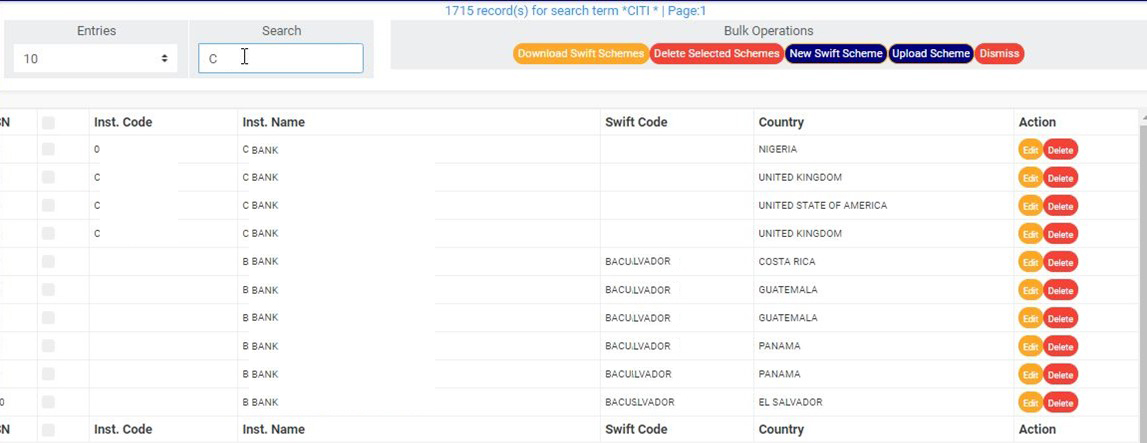
➔ Search for SWIFT Schemes by typing institution code, institution name, or SWIFT code in the search box as in fig. 11.2e below. Search results are immediately.

(fig. 11.2e)

➔ Each institution has two action buttons; ‘Edit’ button and ‘Delete’ button. The different operations are explained below.

How to Edit a SWIFT scheme

NOTE: Only person(s) profiled as deputy supreme Admin and assigned right(s) to “view Swift Dom transactions” and “screen edit Swift Dom transactions’ will be able to carryout this operation.

➔ To change details of an institution;

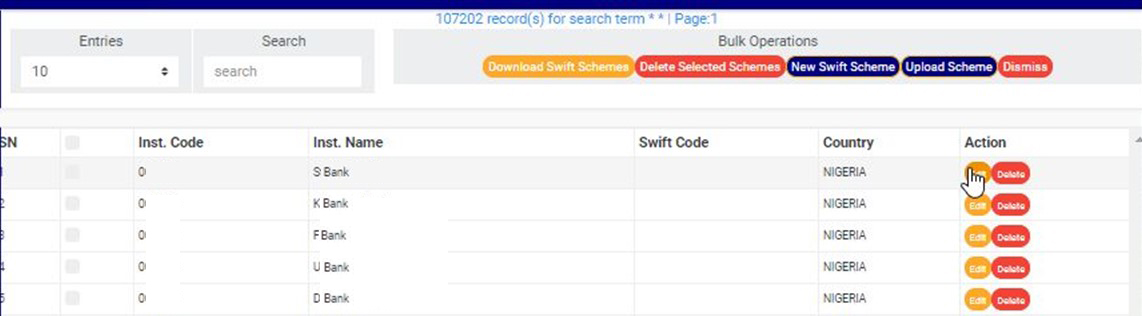
STEP 1: Click on its ‘Edit’ button as shown in the example in fig. 11.2f below.

(fig. 11.2f)

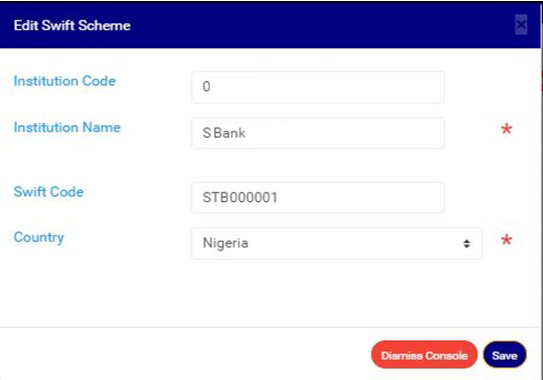
This display an “Edit Swift Scheme” console as in fig. 11.2g.

(fig. 11.2g)

STEP 2: Fill in the details you want to add or change.

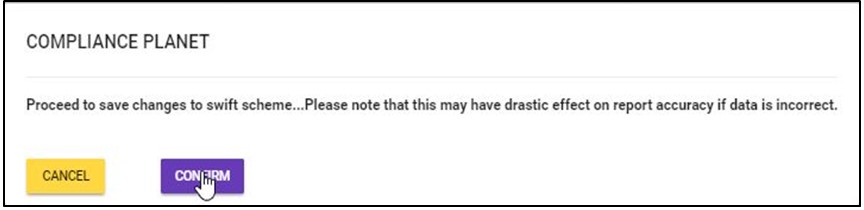
STEP 3: Click on ‘SAVE’ to update the details on the software. Clicking‘Save’ will display a confirmation console as in fig. 11.2h to confirm you want to change the details.

(fig. 11.2h)

➔ Click  ‘CONFIRM’ to save the changes. When the changes are saved, a notification will be displayed at the top of the screen as in fig. 11.2i.

(fig. 11.2i)

How To Delete a SWIFT scheme

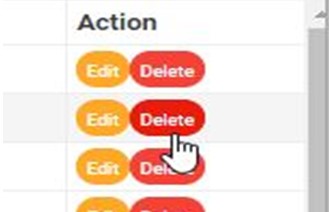
➔ To delete a SWIFT scheme, click on ‘DELETE’ as in fig. 11.2j below.

(fig. 11.2j)

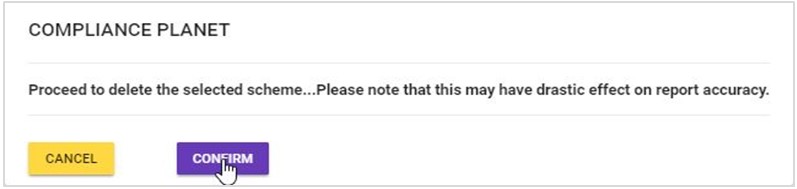
➔ This displays a confirmation console to confirm your request as in fig. 11.2k

(fig. 11.2k)

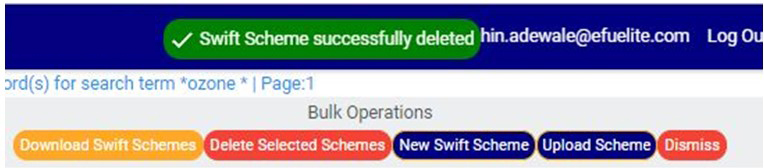
➔ Click on ‘CONFIRM’ to proceed. A notification as shown in fig. 11.2l will also be displayed at the top of the page.

(fig. 11.2l)

How To Carry Out Bulk Swift Operations

NOTE: Only person(s) profiled as deputy supreme Admin and assigned right(s) to “view Swift Dom transactions” and “Bulk edit Swift Dom transactions’ will be able to carryout this operation.

The action buttons available under the bulk operations section of the page as shown in fig. 11.2m include buttons for both individual and bulk operations.

They are;

●Download SWIFT schemes

●Delete selected schemes

●New SWIFT scheme

●Upload scheme

●Dismiss

(fig. 11.2m)

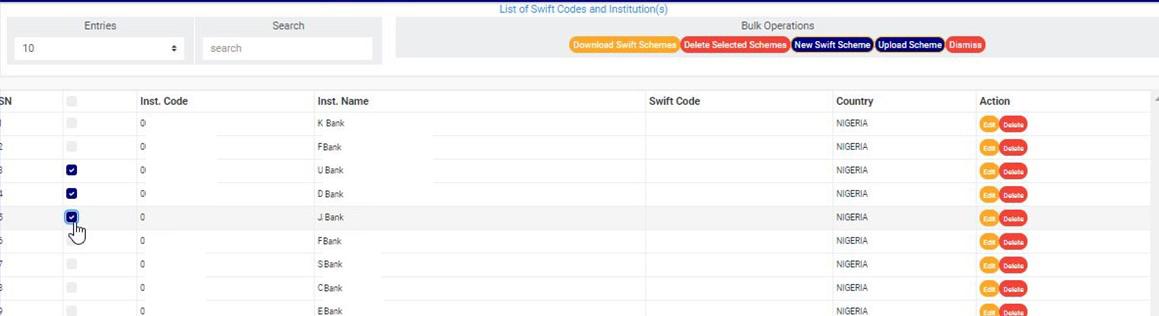
➔ To select a scheme click on its checkbox as shown in the example in fig. 11.2n. Multiple schemes can be selected for bulk operations.

(fig. 11.2n)

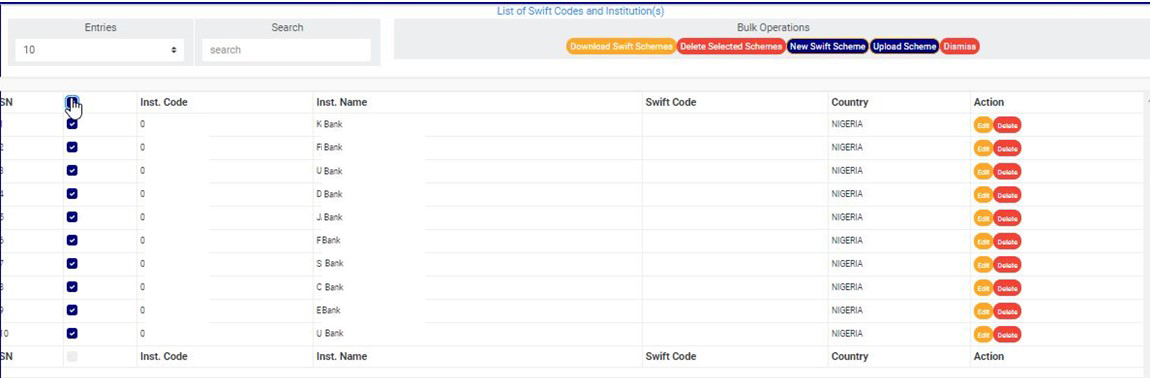
➔ To select or deselect all the schemes on a page, click on the checkbox of the table title bar. This checkbox is between SN and Inst. Code. See fig. 11.2o below.

(fig. 11.2o)

A. How to Download SWIFT Schemes

NOTE: Only person(s) profiled as deputy supreme Admin and assigned right(s) to “view Swift Dom transactions” and “Download Swift Dom transactions’ will be able to carryout this operation.

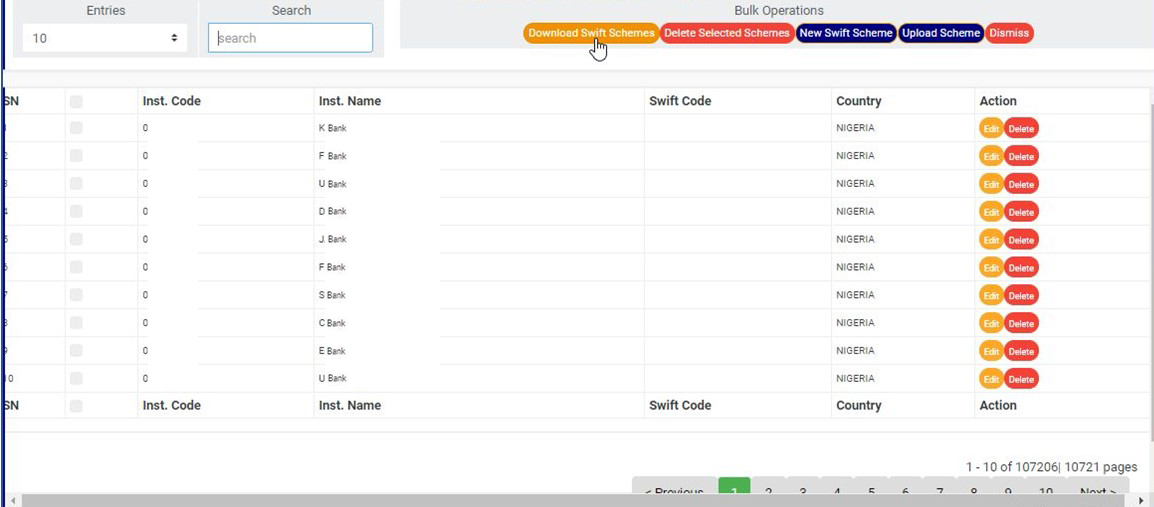
➔ To download all the SWIFT schemes on the planet, click on ‘DOWNLOAD SWIFT SCHEMES’. No need to mark all the schemes.

(fig. 11.2p)

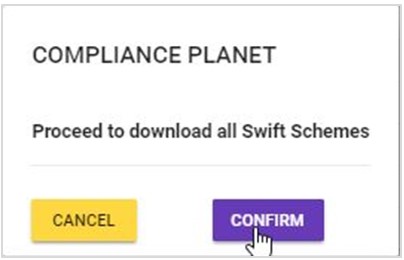
➔ This displays a confirmation console as in fig. 11.2q. Click on ‘CONFIRM’ to proceed with the download or ‘CANCEL’ to stop action.

(fig. 11.2q)

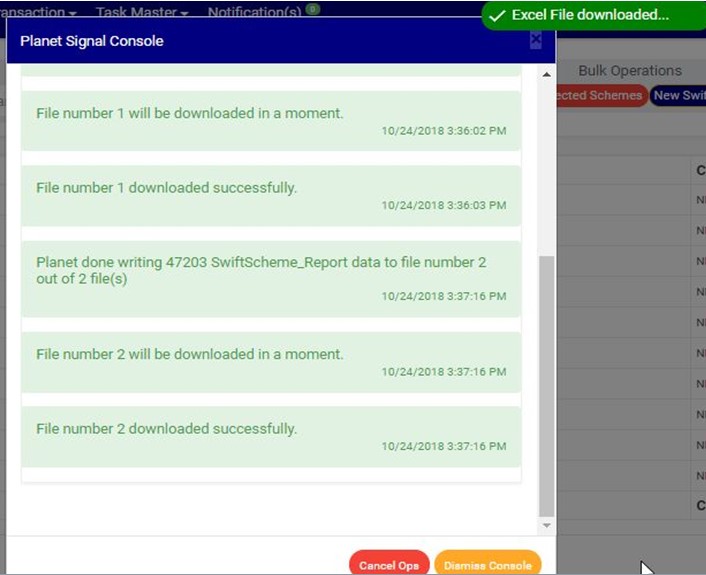
➔The signal console shows on going processes, and when download is complete, a notification will be displayed at the top of the page as shown in fig. 11.2r.

(fig. 11.2r)

B. How to Delete SWIFT Scheme

NOTE: Only person(s) profiled as deputy supreme Admin and assigned right(s) to “view Swift Dom transactions” will be able to carryout this operation.

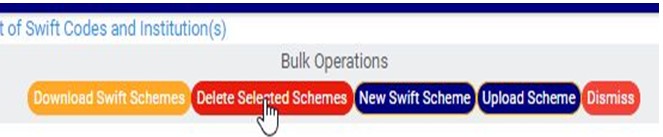
➔ After selecting the SWIFT schemes to be deleted; Click on ‘DELETE SELECTED SCHEMES’ as in fig. 11.2s.

(fig. 11.2s)

➔This displays a confirmation console to confirm your request as shown in fig. 11.2t below.

(fig. 11.2t)

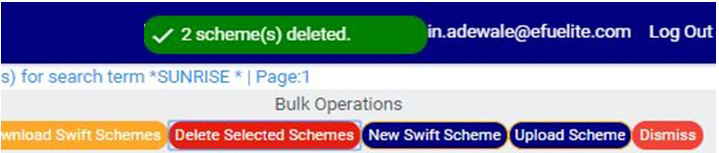
➔ When delete is complete, a notification will be displayed at the top of the page as in fig. 11.2u.

(fig. 11.2u)

C. How to Create A New SWIFT Scheme

NOTE: Only person(s) profiled as deputy supreme Admin and assigned right(s) to “view Swift Dom transactions” will be able to carryout this operation.

➔ To add a new SWIFT scheme on the software, click on ‘NEW SWIFT SCHEME’ as in fig. 11.2v

(fig. 11.2v)

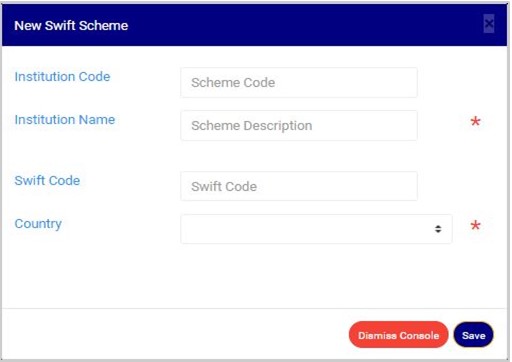
➔ Clicking on the ‘NEW SWIFT SCHEME’ button will display a ‘NEW SWIFT SCHEME’ console as in fig. 11.2w, where you are to input details of the scheme.

(fig. 11.2w)

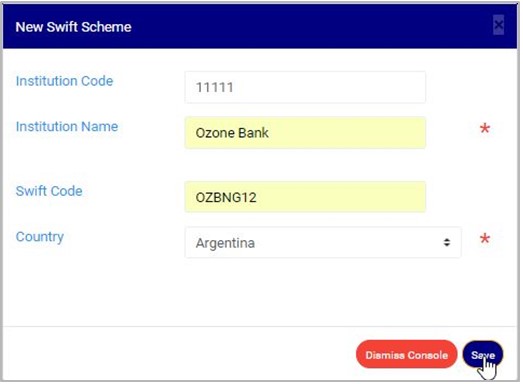
➔ Fill in the details of the new scheme in their respective fields. After inputting the details, click on ‘SAVE’ as shown in fig. 11.2x.

(fig. 11.2x)

➔ This displays a confirmation console to confirm your action. Click on ‘CONFIRM’ to proceed with the creation of a new SWIFT scheme or ‘CANCEL’ to discontinue.

(fig. 11.2y)

➔ If you proceed with adding a new SWIFT scheme, a notification as in fig. 11.2z will be displayed  at the top of the page when the software has successfully created the new SWIFT scheme. The new scheme would be added to the list of SWIFT schemes on the software.

(fig. 11.2z)

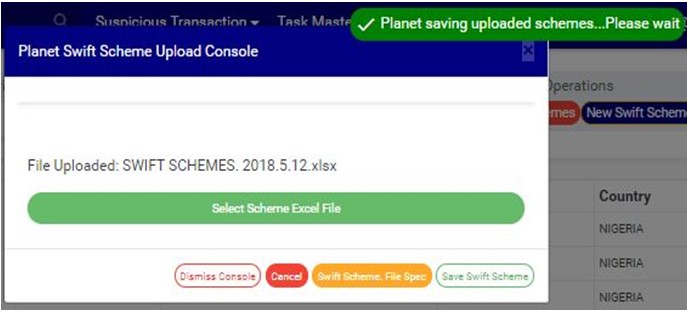
D. How to make Bulk Upload of New SWIFT Schemes.

NOTE: Only person(s) profiled as deputy supreme Admin and assigned right(s) to “view Swift Dom transactions” and “Bulk edit Swift Dom transactions’ will be able to carryout this operation.

➔ To add more than one new SWIFT scheme on the software; you need to upload an excel file filled with the details of the new SWIFT schemes according to the software’s specification for uploading new SWIFT schemes. This process is described below.

STEP 1: Click on ‘UPLOAD SCHEME’ as in fig. 11.2aa below.


(fig. 11.2aa)

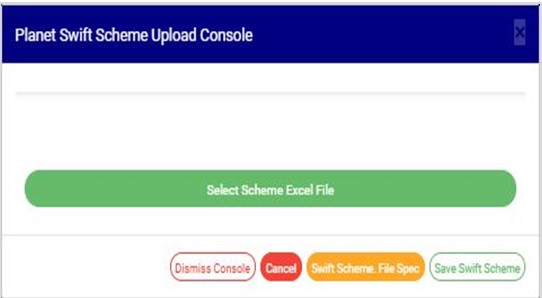
➔ This displays a ‘Swift Scheme Upload’ console as in fig. 11.2ab.

➔ To close the upload console, click on ‘DISMISS CONSOLE’. Note that you can continue the upload from where you stopped by clicking on ‘Upload scheme’.

(fig. 11.2ab)

STEP 2: Click on ‘SELECT SCHEME EXCEL FILE’ as in fig. 11.2ac to choose the excel file filled with the new details to be uploaded on the planet.

(fig. 11.2ac)

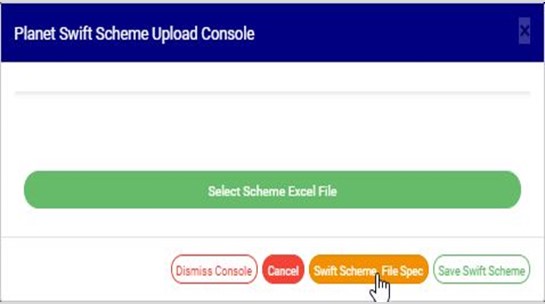
➔ If you do not have the file specification for uploading new details, click on ‘SWIFT SCHEME FILE SPEC.’ as shown in fig. 11.2ad to download an excel file with the required specification.

(fig. 11.2ad)

➔ An excel file will be downloaded to your computer with pre-filled titled columns under which the details will be entered. Open the file, fill in the required details of the new SWIFT schemes and save the changes to the file. Renaming the file on your computer is optional. Now you have a file to upload. Click on ‘Select Scheme Excel File’ to select the file.

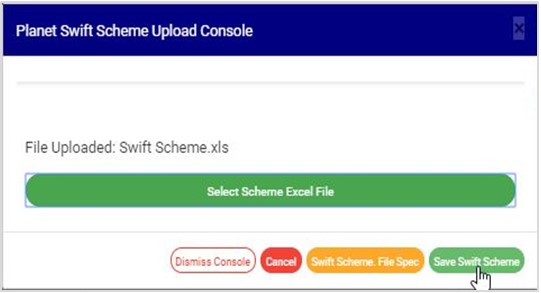
➔ After selecting a file from your computer, the name of the selected file will be added to the upload console. See fig. 11.2ae for an example.

(fig. 11.2ae)

STEP 3: Click on the ‘SAVE SWIFT SCHEME’ button as in fig. 11.2ae above to save the new SWIFT schemes on the software.

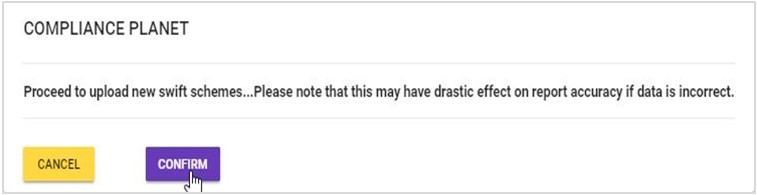
➔ This displays a confirmation console. Click on ‘CONFIRM’ to proceed or ‘CANCEL’ to return to the upload console. See fig. 11.2af.

(fig. 11.2af)

➔ A notification as in fig. 11.2ag will be displayed at the top of the page as the software is saving the new SWIFT schemes.

➔ SWIFT scheme upload report will be downloaded to your computer. This report will give information about the number of schemes (records) uploaded, processed, saved and number of duplicate and exempted schemes.

(fig. 11.2ag)

● ‘DISMISS’ BUTTON

This button is used for closing the SWIFT SCHEME page. Clicking on ‘’DISMISS’ as in fig. 11.2ah below will close the page and take you to the CONTROL PANEL home page as in fig. 11.2a.

(fig. 11.2ah)

For further enquiries :
Tel +234(0) 816 555 9818
Email solutions@efuelite.com

Web http://solutions.efuelite.com

Overview Of Swift Scheme In Compliance Planet Anti Money Laundering/Core Banking Finance Software

This section provides a guide on how to perform operations pertaining to SWIFT Schemes on the Planet, with step-by-step instructions and pictures.

WHAT IS SWIFT?

SWIFT stands for Society for Worldwide Inter bank Financial Telecommunication. The SWIFT system provides a global network that enables financial institutions worldwide to send and receive information about financial transactions in a secure, standardized and reliable environment. It facilitates the transfer of financial messages between financial institutions. Using these messages, banks can exchange data for funds transfer between financial institutions. All financial institutions operating on this network have a SWIFT Code. A SWIFT code is an international bank code that identifies particular banks worldwide. It is also known as a Bank Identifier Code (BIC). It consists of 8 or 11 characters.

Under this control panel feature, the software provides a list of financial institutions and their SWIFT codes. Operations include editing, deleting, downloading and adding new SWIFT codes, with options to carry out operations individually or in bulk.

For further enquiries : 
Tel +234(0) 816 555 9818
Email solutions@efuelite.com 
Web http://solutions.efuelite.com